Wednesday, 18 February 2009
Rolling Stone
There was the head of a small construction firm named Sisyphus - the man, not the firm, and he was asked to put in a quote for a job which involved the pushing of a large boulder up a hill, but- and here was the catch - the boulder would, and noone could satisfactorily explain why, invariably fall back down the hill it had just come up, from where it would have to be pushed back up the hill again, from where again it would... only to... and so on. Sisyphus was in two minds. "We could do with the work, no doubt, but hell, we'll have to charge an awful lot. It's gonna take forever."


The Mirror World
He was gazing with a strange, enrapt expression at his reflection in a large mirror; one would have said not out of vanity but something else... something occult even. And then, as if in a trance, he stepped towards the mirror, as if he meant to actually enter the world behind the glass! And then- well, what do you expect- he banged against the glass and was left, looking now very sober and foolish, wondering what the hell was going on his mind.
Not a Writer
I can't do descriptions, and so, sadly, can't be a writer. A real writer I mean, or someone who can really write. For instance, I look outside. "The roof was wet with rain." That's all right, but anyone could write that. That's not really writing. "The roof was wet with rain like ..." like what? I have no idea. It must have been wet like something else, some lovely little selection of words poetically grouped together, but I have no idea what they are. That's not the way I think. When I see a wet roof, a ditch, a muddy river estuary, I never find myself thinking they look like something else, or feeling the faintest desire to trasmute the sight into the strange medium of words, never mind being able to effect the actual describing itself. No such literary stirrings stir me. I just look. I suppose you could say the one thing I don't see when I look at a field or some other slice of the external world is words. They don't enter my field of vision. Maybe I'm just not looking in the right places.
Tuesday, 17 February 2009
In Sickness Not in Health- More Of
This piece continued. If you're gonna read this, read that first.
"And so we can expect him to be launched on a life of ferocious depravity?"
"Well, perhaps not in the sense you imagine. Have a look at this." And we are looking at a well-to-do man in a well-to-do house gazing serenely from his most elegant and most comfortable armchair at a large wide-screen television set, on which is showing some American programme from some very widely loved television series. It is of course the most mediocre of fare, but given the ordinary(apologies to 'ordinary') standard against which it is judged, well then, this is the most marvellous art. And thank God for the people who make such stuff! What would our poor lives be otherwise?
"But he looks happy and harmless enough. I thought you said he was debased."
"This man grew up reading, or at least sometimes, people like Nietzsche, Beckett, Kierkegaard, Joyce and the like- he's even written books on great sociological, philosophical themes. Of course, he caught that inner illness of telling himself life was sick, but to actually dwell in the ugliness of that landscape is far from pleasant. But it is the mind that led him there. He won't mind having the thought of general sickness in the background; it serves a purpose after all- eliminates the burden and horizon of obligations."
"Obligations to whom?"
"Himself and everyone else, of course. So, it is the mind that led him into that landscape, and there's no need for any attempt to change that land- that sick land is all there is, so what's to change- but, well, life should still be comfortable; what's the point of it all if one doesn't allow oneself these pleasant consolations, and, well, can one really expect to enjoy these comforts if one's mind is telling oneself life is sick and depraved? You've made your nest nice and cosy but your mind is spoiling things a little. So it needs to be cast away, though of course without the awareness of its being cast away; the intellect above everything, after all. And so, here's the answer: the television. That will soothe the savage beast. All those other millions upon millions basking in the communal glow of whatever show from America is busy substituting that almost forgotten world, that of Shakespeare, Mozart, Kafka, Tarkovsky... "But this is art too, I tell you....great art..." And so we leave our contented man, gazing serernely, smothering the nasty, but necessary, thought.
"And so we can expect him to be launched on a life of ferocious depravity?"
"Well, perhaps not in the sense you imagine. Have a look at this." And we are looking at a well-to-do man in a well-to-do house gazing serenely from his most elegant and most comfortable armchair at a large wide-screen television set, on which is showing some American programme from some very widely loved television series. It is of course the most mediocre of fare, but given the ordinary(apologies to 'ordinary') standard against which it is judged, well then, this is the most marvellous art. And thank God for the people who make such stuff! What would our poor lives be otherwise?
"But he looks happy and harmless enough. I thought you said he was debased."
"This man grew up reading, or at least sometimes, people like Nietzsche, Beckett, Kierkegaard, Joyce and the like- he's even written books on great sociological, philosophical themes. Of course, he caught that inner illness of telling himself life was sick, but to actually dwell in the ugliness of that landscape is far from pleasant. But it is the mind that led him there. He won't mind having the thought of general sickness in the background; it serves a purpose after all- eliminates the burden and horizon of obligations."
"Obligations to whom?"
"Himself and everyone else, of course. So, it is the mind that led him into that landscape, and there's no need for any attempt to change that land- that sick land is all there is, so what's to change- but, well, life should still be comfortable; what's the point of it all if one doesn't allow oneself these pleasant consolations, and, well, can one really expect to enjoy these comforts if one's mind is telling oneself life is sick and depraved? You've made your nest nice and cosy but your mind is spoiling things a little. So it needs to be cast away, though of course without the awareness of its being cast away; the intellect above everything, after all. And so, here's the answer: the television. That will soothe the savage beast. All those other millions upon millions basking in the communal glow of whatever show from America is busy substituting that almost forgotten world, that of Shakespeare, Mozart, Kafka, Tarkovsky... "But this is art too, I tell you....great art..." And so we leave our contented man, gazing serernely, smothering the nasty, but necessary, thought.
Monday, 16 February 2009
Existential Historical
"Oh God, here we go again. More solipsistic nonsense."
Solipsistic? Nonsense. I accept the existence of the reader as an existential fact."
"Thank God for that."
"It's the writer I deny."
"The writer? But that's you. How can you deny your own existence?"
"Let me explain. Within a slice of historical time, a written piece, for example this one, is indeed written. In fact, this is being written right now, but that 'right now' no longer exists in the sense implied, but it does exist precisely 'right now' and only 'right now' when being read. So the reader here exists as existential fact, but the writer merely as historical fact, and is there anything more dubious than an historical fact?"
"Okay, but you should know there's been complaints."
"Complaints?"
"Yes, complaints. 'A lack of plausible characters.'"
Pause. "Well what do you think?"
"About what?"
"What do you think?! The bloody complaint. Do you find your existence plausible?"
"Well yes, of course. But what else do you expect me to say? I don't know anything else."
"Well if you don't know anything else, then what are you complaining about?"
"I'm not the one complaining."
"Well tell whoever is the same thing I just told you, and see what he says."
Solipsistic? Nonsense. I accept the existence of the reader as an existential fact."
"Thank God for that."
"It's the writer I deny."
"The writer? But that's you. How can you deny your own existence?"
"Let me explain. Within a slice of historical time, a written piece, for example this one, is indeed written. In fact, this is being written right now, but that 'right now' no longer exists in the sense implied, but it does exist precisely 'right now' and only 'right now' when being read. So the reader here exists as existential fact, but the writer merely as historical fact, and is there anything more dubious than an historical fact?"
"Okay, but you should know there's been complaints."
"Complaints?"
"Yes, complaints. 'A lack of plausible characters.'"
Pause. "Well what do you think?"
"About what?"
"What do you think?! The bloody complaint. Do you find your existence plausible?"
"Well yes, of course. But what else do you expect me to say? I don't know anything else."
"Well if you don't know anything else, then what are you complaining about?"
"I'm not the one complaining."
"Well tell whoever is the same thing I just told you, and see what he says."
Saturday, 14 February 2009
In Sickness Not in Health
Western intellectual man, if such a man still exists- perhaps he surfaces during ad breaks- is, or at least was, a great hypochondriac: he keeps telling himself he is sick.
"Ah, but to exist is to be sick."
"But he only feels himself to be sick because he keeps telling himself he is sick."
"No, he tells himself he is sick because he really is sick."
There, what did I tell you. Because the thoughts in his thought-filled being are sick, then voila, the proof of his wisdom all wrapped up in itself.
He kept telling himself he was sick and that he required something to be made better- the right words in the right order perhaps. After enough time of telling himself he is sick, and the inevitable non-appearance of contradicting health, he becomes convinced that this sickness is all there is; there is no getting better as there is no 'better'.
Rather than his unhappiness being the thread that is calling him out of his misery- the intimation that he is going wrong, immersed in false form- he makes himself at home in this sick world, and, justifying the lack of effort to get out of this ugliness, even makes a philosophy of truth out of this baseness: "All is sick. The honest men realise this. It is the ones who say that sickness is not truth who are dishonest." Now he is free to really roll around in the muck, fill his nostrils with the stuff.
"Ah, but to exist is to be sick."
"But he only feels himself to be sick because he keeps telling himself he is sick."
"No, he tells himself he is sick because he really is sick."
There, what did I tell you. Because the thoughts in his thought-filled being are sick, then voila, the proof of his wisdom all wrapped up in itself.
He kept telling himself he was sick and that he required something to be made better- the right words in the right order perhaps. After enough time of telling himself he is sick, and the inevitable non-appearance of contradicting health, he becomes convinced that this sickness is all there is; there is no getting better as there is no 'better'.
Rather than his unhappiness being the thread that is calling him out of his misery- the intimation that he is going wrong, immersed in false form- he makes himself at home in this sick world, and, justifying the lack of effort to get out of this ugliness, even makes a philosophy of truth out of this baseness: "All is sick. The honest men realise this. It is the ones who say that sickness is not truth who are dishonest." Now he is free to really roll around in the muck, fill his nostrils with the stuff.
Friday, 13 February 2009
Correct Order
The writing that follows was actually written before this here which merely serves as an introduction to that which was already written. Why that should be of interest to anyone is not my business to know- the reader's inner life is his own- but that it may be of interest is, like all possible things, certainly possible.
"Yes but the mere fact of something being possible shouldn't be enough to make it a literary fact. The writer must choose the essential." A literary fact, you say? Does the mere fact of it being written make it a fact? Well, I suppose if being written isn't enough to make something a literary fact, then what is? But perhaps we better clarify things. Are individual words literary facts? At the atomic level, yes, the individual word lives. Look up a dictionary if you don't believe me. But what good is a word in isolation? "Celebrated", for example. On its own it's almost embarrassing. It requires a wider context, the fellowship of accompaniment.
Anyway, as said, what follows the beginning was already written before the first bit. "But how do we know?" says you, kindly assuming the existence of more than one of you. It's a good point, and unfortunately I am unable to respond in any kind of satisfactory manner. You don't and can't know what was written first, though why you should be bothered in the first place is itself interesting...well, not quite interesting. Perhaps you are interested because you are a little pedantic. A lot of people do very well in life precisely by virtue of their pedantry. Or at least they might. I hadn't really thought about it before now. To be honest I'm not even really thinking about it now. But to put your mind at ease, not that that's really in my power, if you want to know in what order this was written, well then you'll have to take my word for it. It poured itself out in precisely the order I alluded to earlier: what came later, which of course includes this, was actually written first, and that's not all. It's actually much more experimental again. The entire piece was originally written backwards, but subsequently inverted out of consideration and respect for the reader.
"Yes but the mere fact of something being possible shouldn't be enough to make it a literary fact. The writer must choose the essential." A literary fact, you say? Does the mere fact of it being written make it a fact? Well, I suppose if being written isn't enough to make something a literary fact, then what is? But perhaps we better clarify things. Are individual words literary facts? At the atomic level, yes, the individual word lives. Look up a dictionary if you don't believe me. But what good is a word in isolation? "Celebrated", for example. On its own it's almost embarrassing. It requires a wider context, the fellowship of accompaniment.
Anyway, as said, what follows the beginning was already written before the first bit. "But how do we know?" says you, kindly assuming the existence of more than one of you. It's a good point, and unfortunately I am unable to respond in any kind of satisfactory manner. You don't and can't know what was written first, though why you should be bothered in the first place is itself interesting...well, not quite interesting. Perhaps you are interested because you are a little pedantic. A lot of people do very well in life precisely by virtue of their pedantry. Or at least they might. I hadn't really thought about it before now. To be honest I'm not even really thinking about it now. But to put your mind at ease, not that that's really in my power, if you want to know in what order this was written, well then you'll have to take my word for it. It poured itself out in precisely the order I alluded to earlier: what came later, which of course includes this, was actually written first, and that's not all. It's actually much more experimental again. The entire piece was originally written backwards, but subsequently inverted out of consideration and respect for the reader.
Sunday, 8 February 2009
From Ignorance to Knowledge
Regarding the notion of self-knowledge or the movement from inner spiritual or philosophical ignorance to knowledge: Movement from a starting point of A to a destination point of B presupposes the existence of both A and B. But insofar as the independent existence of points apart from the whole within which they have their existence is obviously illusory, so the mind's movement from ignorance to knowledge is illusory, merely a conceptual notion of the mind in the first place. One could also point out, how can ignorance of reality be a real point within reality, which is a necessary feature of this ignorance to knowledge movement.
The Intellectual Koan
A monk asked, "All things are said to be reducible to the One, but where is the One to be reduced?" Chao-chou answered, "When I was in the district of Ch'ing I had a robe that weighed seven chin."
D.T. Suzuki offers the above as an example of the koan exercise in his essay The Reason of Unreason: the Koan Exercise, and says:
The worst enemy of Zen experience, at least in the beginning, is the intellect, which consists and insists in discriminating subject from object. The discriminating intellect, therefore, must be cut short if Zen consciousness is to unfold itself, and the koan is constructed entirely to serve this end...A psychological impasse is the necessary antecedent of satori, and we at once notice that there is no room in the koan to insert an intellectual interpretation. The wall against which the Yogin has been beating( in trying with his intellect to 'solve' the koan) hitherto to no purpose breaks down, and an entirely new vista of consciousness opens before him.
Well if the discipline does yield the desired results, then there is no questioning its usefulness, but I suspect the koan is perhaps too removed from Western consciousness to be an especially fruitful discipline here- taking my own self as a symptom rather than a case in isolation. Rather than feel compelled to attack with my mind the koan, thus hopefully yielding the results, it simply doesn't especially interest me, and not having supplied the necessary mental tension there arise no results.
What is essentially being aspired to here is the movement from the finite to the infinite, from the centre of the intellect bound self to the living state of consciousness which actually produces the manifestations of intellect, from the abstraction of a word sustained sense of being to the organic centre of actual life. However, thought is a manifestation of the mind and perhaps through the very route of thought itself a different but related path can be cut leading to the same desired inner destination. And this is the point in what probably appears a strange, pointless post recently like Another Trapdoor, where was written:
This shouldn't be written.
Well, what is so interesting about that? Like the koan a rational explanation is the enemy for there the intellect finds a place of rest, a meaning, and it moves on very much as it already was, and so 'explanation' is very double-edged, but here perhaps necessary, given how unusual this form of thought actually is. What I presume is most likely happens with this line is that the reader sees "This shouldn't be written", and moves immediately along the normal logical path the mind works on, and for a brief moment wonders why it shouldn't be written, doesn't know, finds it a bit strange, pointless and inelegant, an odd essay in humour perhaps; and moves on to read something else. But am I trying to claim there is something extraordinary about such a simple line?
The line is not preceded by something like, "All humans are scum and deserve to die", then followed by- "This shouldn't be written." No, all we have is "This shouldn't be written."
'So you're saying "This shouldn't be written" shouldn't be written? Why not?'
No, that's not what is written. Such a reader isn't looking at the line with enough directness, but jumping aboard the normal logical routes to the imagined intellectual destination. But here we just have "This shouldn't be written", not "This shouldn't be written shouldn't be written." But here is the point and the problem in explication for me- I cannot do the work for the reader. It's a thought that has no linguistic flaws, is perfectly ordinary, and yet the mind cannot find rest in it. It defies the normal logical path, but is not an illogical line.
"Do you mean 'This' shouldn't be written, as in the word 'this'? No, you're not looking directly enough. All we have is the line "This shouldn't be written."
"Well what does the "'This' in the line refer to?" "Ah, now we're getting somewhere. 'This' refers to the line 'This shouldn't be written"...
And because the train of thought is itself the enemy to the direct existential perception, the isolated line again:
This shouldn't be written.
An earlier similar thought produced repeated below, later examined with reluctance here:
This is a translation.
D.T. Suzuki offers the above as an example of the koan exercise in his essay The Reason of Unreason: the Koan Exercise, and says:
The worst enemy of Zen experience, at least in the beginning, is the intellect, which consists and insists in discriminating subject from object. The discriminating intellect, therefore, must be cut short if Zen consciousness is to unfold itself, and the koan is constructed entirely to serve this end...A psychological impasse is the necessary antecedent of satori, and we at once notice that there is no room in the koan to insert an intellectual interpretation. The wall against which the Yogin has been beating( in trying with his intellect to 'solve' the koan) hitherto to no purpose breaks down, and an entirely new vista of consciousness opens before him.
Well if the discipline does yield the desired results, then there is no questioning its usefulness, but I suspect the koan is perhaps too removed from Western consciousness to be an especially fruitful discipline here- taking my own self as a symptom rather than a case in isolation. Rather than feel compelled to attack with my mind the koan, thus hopefully yielding the results, it simply doesn't especially interest me, and not having supplied the necessary mental tension there arise no results.
What is essentially being aspired to here is the movement from the finite to the infinite, from the centre of the intellect bound self to the living state of consciousness which actually produces the manifestations of intellect, from the abstraction of a word sustained sense of being to the organic centre of actual life. However, thought is a manifestation of the mind and perhaps through the very route of thought itself a different but related path can be cut leading to the same desired inner destination. And this is the point in what probably appears a strange, pointless post recently like Another Trapdoor, where was written:
This shouldn't be written.
Well, what is so interesting about that? Like the koan a rational explanation is the enemy for there the intellect finds a place of rest, a meaning, and it moves on very much as it already was, and so 'explanation' is very double-edged, but here perhaps necessary, given how unusual this form of thought actually is. What I presume is most likely happens with this line is that the reader sees "This shouldn't be written", and moves immediately along the normal logical path the mind works on, and for a brief moment wonders why it shouldn't be written, doesn't know, finds it a bit strange, pointless and inelegant, an odd essay in humour perhaps; and moves on to read something else. But am I trying to claim there is something extraordinary about such a simple line?
The line is not preceded by something like, "All humans are scum and deserve to die", then followed by- "This shouldn't be written." No, all we have is "This shouldn't be written."
'So you're saying "This shouldn't be written" shouldn't be written? Why not?'
No, that's not what is written. Such a reader isn't looking at the line with enough directness, but jumping aboard the normal logical routes to the imagined intellectual destination. But here we just have "This shouldn't be written", not "This shouldn't be written shouldn't be written." But here is the point and the problem in explication for me- I cannot do the work for the reader. It's a thought that has no linguistic flaws, is perfectly ordinary, and yet the mind cannot find rest in it. It defies the normal logical path, but is not an illogical line.
"Do you mean 'This' shouldn't be written, as in the word 'this'? No, you're not looking directly enough. All we have is the line "This shouldn't be written."
"Well what does the "'This' in the line refer to?" "Ah, now we're getting somewhere. 'This' refers to the line 'This shouldn't be written"...
And because the train of thought is itself the enemy to the direct existential perception, the isolated line again:
This shouldn't be written.
An earlier similar thought produced repeated below, later examined with reluctance here:
This is a translation.
Thursday, 5 February 2009
A Glimpse Into the Engine-Room of Literature
"Ah, this conversation is going nowhere!"
"You only just started it."
"No, no, that's just the first line. I'm trying to give the impression we're in the middle of some heated discussion."
"And what am I supposed to do?"
"Keep going- make something up."
"Okay, give me a second...But Bismarck was a fool, I tell you."
"What?"
"You know... Bismarck- Prussian Chancellor, unification of Germany..."
"I know who Bismarck was. What the hell put him into your head?"
"I don't know. Just the first thing that came to mind."
"And what kind of conversation do do you think we can end up having about him?"
"I don't know. Maybe we could try blaming him for World War One, and move on from there."
"Ah this is so stupid. Who's going to want to read this kind of rubbish?"
"You never know. There might be an audience out there crying out for exactly this kind of thing."
"No there isn't."
"All right, all right, I'll think of something else."
"Forget it. We'll end up looking even bigger fools."
"You only just started it."
"No, no, that's just the first line. I'm trying to give the impression we're in the middle of some heated discussion."
"And what am I supposed to do?"
"Keep going- make something up."
"Okay, give me a second...But Bismarck was a fool, I tell you."
"What?"
"You know... Bismarck- Prussian Chancellor, unification of Germany..."
"I know who Bismarck was. What the hell put him into your head?"
"I don't know. Just the first thing that came to mind."
"And what kind of conversation do do you think we can end up having about him?"
"I don't know. Maybe we could try blaming him for World War One, and move on from there."
"Ah this is so stupid. Who's going to want to read this kind of rubbish?"
"You never know. There might be an audience out there crying out for exactly this kind of thing."
"No there isn't."
"All right, all right, I'll think of something else."
"Forget it. We'll end up looking even bigger fools."
In Essence
"What is thought of as philosophy can generally be described as a kind of debased, third-rate hashish experience."
"What do you mean?"
""Isn't it obvious? You get all the endless, self-generating paranoiacal nonsense, but without the getting high."
"What do you mean?"
""Isn't it obvious? You get all the endless, self-generating paranoiacal nonsense, but without the getting high."
Wednesday, 4 February 2009
Tuesday, 3 February 2009
Wall Street and the Bolshevik Revolution
Below from the titled book, all online here, by Anthony Sutton. Sutton was an economics professor at California State University Los Angeles and a research fellow at Stanford University's Hoover Institution from 1968 to 1973. During his time at the Hoover Institute he wrote the major study Western Technology and Soviet Economic Development (in three volumes), detailing how the West played a major role in developing Soviet Union from its very beginnings up until the present time (1970). He was forced out of the Hoover Institute after publishing National Suicide: Military Aid to the Soviet Union in 1973.
Dear Mr. President:
I am in sympathy with the Soviet form of government as that best suited for the Russian people...
Letter to President Woodrow Wilson (October 17, 1918) from William Lawrence Saunders, chairman, Ingersoll-Rand Corp.; director, American International Corp.; and deputy chairman, Federal Reserve Bank of New York
Author's preface
Since the early 1920s, numerous pamphlets and articles, even a few books, have sought to forge a link between "international bankers" and "Bolshevik revolutionaries." Rarely have these attempts been supported by hard evidence, and never have such attempts been argued within the framework of a scientific methodology. Indeed, some of the"evidence" used in these efforts has been fraudulent, some has been irrelevant, much cannot be checked. Examination of the topic by academic writers has been studiously avoided; probably because the hypothesis offends the neat dichotomy of capitalists versus Communists (and everyone knows, of course, that these are bitter enemies). Moreover, because a great deal that has been written borders on the absurd, a sound academic reputation could easily be wrecked on the shoals of ridicule. Reason enough to avoid the topic.
Fortunately, the State Department Decimal File, particularly the 861.00 section, contains extensive documentation on the hypothesized link. When the evidence in these official papers is merged with non-official evidence from biographies, personal papers, and conventional histories, a truly fascinating story emerges.
We find there was a link between some New York international bankers and many revolutionaries, including Bolsheviks. These banking gentlemen -- who are here identified -- had a financial stake in, and were rooting for, the success of the Bolshevik Revolution.
Who, why -- and for how much -- is the story in this book.
Antony C. Sutton
March 1974
The frontispiece in this book was drawn by cartoonist Robert Minor in 1911 for the St. Louis Post-Dispatch. Minor was a talented artist and writer who doubled as a Bolshevik revolutionary, got himself arrested in Russia in 1915 for alleged subversion, and was later bank-rolled by prominent Wall Street financiers. Minor's cartoon portrays a bearded, beaming Karl Marx standing in Wall Street with Socialism tucked under his arm and accepting the congratulations of financial luminaries J.P. Morgan, Morgan partner George W. Perkins, a smug John D. Rockefeller, John D. Ryan of National City Bank, and Teddy Roosevelt -- prominently identified by his famous teeth -- in the background. Wall Street is decorated by Red flags.
Was Robert Minor dreaming? On the contrary, we shall see that Minor was on firm ground in depicting an enthusiastic alliance of Wall Street and Marxist socialism. The characters in Minor's cartoon -- Karl Marx (symbolizing the future revolutionaries Lenin and Trotsky), J. P. Morgan, John D. Rockefeller -- and indeed Robert Minor himself, are also prominent characters in this book.
The contradictions suggested by Minor's cartoon have been brushed under the rug of history because they do not fit the accepted conceptual spectrum of political left and political right. Bolsheviks are at the left end of the political spectrum and Wall Street financiers are at the right end; therefore, we implicitly reason, the two groups have nothing in common and any alliance between the two is absurd. Factors contrary to this neat conceptual arrangement are usually rejected as bizarre observations or unfortunate errors.
On the other hand, it may be observed that both the extreme right and the extreme left of the conventional political spectrum are absolutely collectivist. The national socialist (for example, the fascist) and the international socialist (for example, the communist) both recommend totalitarian politico-economic systems based on naked, unfettered political power and individual coercion. Both systems require monopoly control of society.
While monopoly control of industries was once the objective of J.P. Morgan and J.D. Rockefeller, by the late nineteenth century the inner sanctums of Wall Street understood that the most efficient way to gain an unchallenged monopoly was to "go political" and make society go to work for the monopolists -- under the name of the public good and the public interest. This strategy was detailed in 1906 by Frederick C. Howe in his Confessions of a Monopolist.
Consequently, one barrier to mature understanding of recent history is the notion that all capitalists are the bitter and unswerving enemies of all Marxists and socialists. This erroneous idea originated with Karl Marx and was undoubtedly useful to his purposes. In fact, the idea is nonsense. There has been a continuing, albeit concealed, alliance between international political capitalists and international revolutionary socialists -- to their mutual benefit. This alliance has gone unobserved largely because historians -- with a few notable exceptions -- have an unconscious Marxian bias and are thus locked into the impossibility of any such alliance existing. The open-minded reader should bear two clues in mind: monopoly capitalists are the bitter enemies of laissez-faire entrepreneurs; and, given the weaknesses of socialist central planning, the totalitarian socialist state is a perfect captive market for monopoly capitalists, if an alliance can be made with the socialist powerbrokers. Suppose -- and it is only hypothesis at this point -- that American monopoly capitalists were able to reduce a planned socialist Russia to the status of a captive technical colony? Would not this be the logical twentieth-century internationalist extension of the Morgan railroad monopolies and the Rockefeller petroleum trust of the late nineteenth century?
In brief, this is a story of the Bolshevik Revolution and its aftermath, but a story that departs from the usual conceptual straitjacket approach of capitalists versus communists. Our story postulates a partnership between international monopoly capitalism and international revolutionary socialism for their mutual benefit. The final human cost of this alliance has fallen upon the shoulders of the individual Russian and the individual American. Entrepreneurship has been brought into disrepute and the world has been propelled toward inefficient socialist planning as a result of these monopoly maneuverings in the world of politics and revolution.
This is also a story reflecting the betrayal of the Russian Revolution. The tsars and their corrupt political system were ejected only to be replaced by the new powerbrokers of another corrupt political system. Where the United States could have exerted its dominant influence to bring about a free Russia it truckled to the ambitions of a few Wall Street financiers who, for their own purposes, could accept a centralized tsarist Russia or a centralized Marxist Russia but not a decentralized free Russia. And the reasons for these assertions will unfold as we develop the underlying and, so far, untold history of the Russian Revolution and its aftermath.
And the link again here to continue reading.
Dear Mr. President:
I am in sympathy with the Soviet form of government as that best suited for the Russian people...
Letter to President Woodrow Wilson (October 17, 1918) from William Lawrence Saunders, chairman, Ingersoll-Rand Corp.; director, American International Corp.; and deputy chairman, Federal Reserve Bank of New York
Author's preface
Since the early 1920s, numerous pamphlets and articles, even a few books, have sought to forge a link between "international bankers" and "Bolshevik revolutionaries." Rarely have these attempts been supported by hard evidence, and never have such attempts been argued within the framework of a scientific methodology. Indeed, some of the"evidence" used in these efforts has been fraudulent, some has been irrelevant, much cannot be checked. Examination of the topic by academic writers has been studiously avoided; probably because the hypothesis offends the neat dichotomy of capitalists versus Communists (and everyone knows, of course, that these are bitter enemies). Moreover, because a great deal that has been written borders on the absurd, a sound academic reputation could easily be wrecked on the shoals of ridicule. Reason enough to avoid the topic.
Fortunately, the State Department Decimal File, particularly the 861.00 section, contains extensive documentation on the hypothesized link. When the evidence in these official papers is merged with non-official evidence from biographies, personal papers, and conventional histories, a truly fascinating story emerges.
We find there was a link between some New York international bankers and many revolutionaries, including Bolsheviks. These banking gentlemen -- who are here identified -- had a financial stake in, and were rooting for, the success of the Bolshevik Revolution.
Who, why -- and for how much -- is the story in this book.
Antony C. Sutton
March 1974
The frontispiece in this book was drawn by cartoonist Robert Minor in 1911 for the St. Louis Post-Dispatch. Minor was a talented artist and writer who doubled as a Bolshevik revolutionary, got himself arrested in Russia in 1915 for alleged subversion, and was later bank-rolled by prominent Wall Street financiers. Minor's cartoon portrays a bearded, beaming Karl Marx standing in Wall Street with Socialism tucked under his arm and accepting the congratulations of financial luminaries J.P. Morgan, Morgan partner George W. Perkins, a smug John D. Rockefeller, John D. Ryan of National City Bank, and Teddy Roosevelt -- prominently identified by his famous teeth -- in the background. Wall Street is decorated by Red flags.
Was Robert Minor dreaming? On the contrary, we shall see that Minor was on firm ground in depicting an enthusiastic alliance of Wall Street and Marxist socialism. The characters in Minor's cartoon -- Karl Marx (symbolizing the future revolutionaries Lenin and Trotsky), J. P. Morgan, John D. Rockefeller -- and indeed Robert Minor himself, are also prominent characters in this book.
The contradictions suggested by Minor's cartoon have been brushed under the rug of history because they do not fit the accepted conceptual spectrum of political left and political right. Bolsheviks are at the left end of the political spectrum and Wall Street financiers are at the right end; therefore, we implicitly reason, the two groups have nothing in common and any alliance between the two is absurd. Factors contrary to this neat conceptual arrangement are usually rejected as bizarre observations or unfortunate errors.
On the other hand, it may be observed that both the extreme right and the extreme left of the conventional political spectrum are absolutely collectivist. The national socialist (for example, the fascist) and the international socialist (for example, the communist) both recommend totalitarian politico-economic systems based on naked, unfettered political power and individual coercion. Both systems require monopoly control of society.
While monopoly control of industries was once the objective of J.P. Morgan and J.D. Rockefeller, by the late nineteenth century the inner sanctums of Wall Street understood that the most efficient way to gain an unchallenged monopoly was to "go political" and make society go to work for the monopolists -- under the name of the public good and the public interest. This strategy was detailed in 1906 by Frederick C. Howe in his Confessions of a Monopolist.
Consequently, one barrier to mature understanding of recent history is the notion that all capitalists are the bitter and unswerving enemies of all Marxists and socialists. This erroneous idea originated with Karl Marx and was undoubtedly useful to his purposes. In fact, the idea is nonsense. There has been a continuing, albeit concealed, alliance between international political capitalists and international revolutionary socialists -- to their mutual benefit. This alliance has gone unobserved largely because historians -- with a few notable exceptions -- have an unconscious Marxian bias and are thus locked into the impossibility of any such alliance existing. The open-minded reader should bear two clues in mind: monopoly capitalists are the bitter enemies of laissez-faire entrepreneurs; and, given the weaknesses of socialist central planning, the totalitarian socialist state is a perfect captive market for monopoly capitalists, if an alliance can be made with the socialist powerbrokers. Suppose -- and it is only hypothesis at this point -- that American monopoly capitalists were able to reduce a planned socialist Russia to the status of a captive technical colony? Would not this be the logical twentieth-century internationalist extension of the Morgan railroad monopolies and the Rockefeller petroleum trust of the late nineteenth century?
In brief, this is a story of the Bolshevik Revolution and its aftermath, but a story that departs from the usual conceptual straitjacket approach of capitalists versus communists. Our story postulates a partnership between international monopoly capitalism and international revolutionary socialism for their mutual benefit. The final human cost of this alliance has fallen upon the shoulders of the individual Russian and the individual American. Entrepreneurship has been brought into disrepute and the world has been propelled toward inefficient socialist planning as a result of these monopoly maneuverings in the world of politics and revolution.
This is also a story reflecting the betrayal of the Russian Revolution. The tsars and their corrupt political system were ejected only to be replaced by the new powerbrokers of another corrupt political system. Where the United States could have exerted its dominant influence to bring about a free Russia it truckled to the ambitions of a few Wall Street financiers who, for their own purposes, could accept a centralized tsarist Russia or a centralized Marxist Russia but not a decentralized free Russia. And the reasons for these assertions will unfold as we develop the underlying and, so far, untold history of the Russian Revolution and its aftermath.
And the link again here to continue reading.
The Free
Out walking, I came to a field in which were a large number of people tied by various lengths of rope to posts stuck in the ground, around which they were walking. Though the circumference of the individual's world was determined by the length of his rope, each seemed oblivious to its very existence.
It was hard to hear but I did catch a snatch or two of conversation. "I am free." "Yes, we are all free."
And also, thanks to a little stealth, this exchange between two haughty looking men who were attached to cords of slightly longer length than the norm. "They think they are free but are not." The other smiled. "True, but we are."
The other chuckled. "Of course. And our awareness of their not being free makes us all the more so." I walked on.
It was hard to hear but I did catch a snatch or two of conversation. "I am free." "Yes, we are all free."
And also, thanks to a little stealth, this exchange between two haughty looking men who were attached to cords of slightly longer length than the norm. "They think they are free but are not." The other smiled. "True, but we are."
The other chuckled. "Of course. And our awareness of their not being free makes us all the more so." I walked on.
Bed Wridden
"What's that fella doing in the bed with all that paper?"
"Him? Oh, he's been at that for years. He's capturing the past."
"But isn't the past past? Gone?"
"Oh no, he has it all written down."
"Him? Oh, he's been at that for years. He's capturing the past."
"But isn't the past past? Gone?"
"Oh no, he has it all written down."
Monday, 2 February 2009
Saturday, 31 January 2009
The Reactionary
"Look carefully. I have a bucket with nothing in it. But if I turn it upside down I still have nothing in it. Thus is gravity disproven."
The Light
"Look, there's light at the end of the tunnel!" And there was, but unfortunately it was soon revealed to be the wrong end, and the light merely a naked 40 watt bulb, emitting also a light buzzing sound.
Dispute
This is a fragment of a future novel that will almost certainly remain unpublished, and indeed unwritten, due to the forces of depravity and ignorance that engulf the common man. The scene takes place in the office of one of the two central protagonists, both of whom are Marxist historians, working in a modern academic institution, perhaps near you. Though the characters are fictitious their identities will remain in obscurity, for fear of defaming the non-existent.
"You're a fucking shit lecturer, and an even worse historian."
"No I'm not."
"Yes you fucking are."
"Then what about my analysis of the Cuban missile crisis? Featherby said it was masterful."
"You got lucky."
"Luck had nothing to do with it."
"Luck had everything to do with it. Your Diet of Worms parallel was suggested to you by some stoned student who neither knew nor fucking cared whether he was coming or going."
"That's a goddamn lie."
"You know it's not, and I've got the fucking tape to prove it."
"Erra who gives a shit anyway? We're the only two people who know what the hell we're talking about."
"And we don't even fucking exist."
"True."
"You're a fucking shit lecturer, and an even worse historian."
"No I'm not."
"Yes you fucking are."
"Then what about my analysis of the Cuban missile crisis? Featherby said it was masterful."
"You got lucky."
"Luck had nothing to do with it."
"Luck had everything to do with it. Your Diet of Worms parallel was suggested to you by some stoned student who neither knew nor fucking cared whether he was coming or going."
"That's a goddamn lie."
"You know it's not, and I've got the fucking tape to prove it."
"Erra who gives a shit anyway? We're the only two people who know what the hell we're talking about."
"And we don't even fucking exist."
"True."
Thursday, 29 January 2009
Ayne Bru- Saint Candidus c.1500
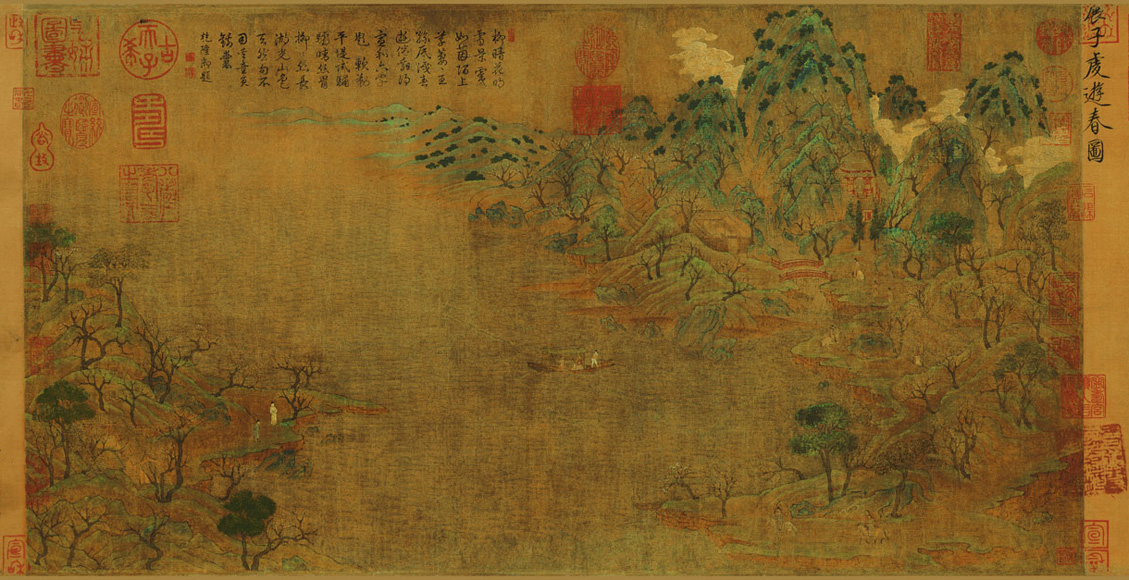
 I have received a steady, occasionally unsteady, stream of virulent abuse from various corners of the globe( allowing for the contradiction of globes and corners) for not having posted any images by the not particularly famous Spanish artist Ayne Bru, and so with a little reluctance, if only towards the possible perception that the I am simply bowing to pressure rather than truly exercising my own independent will, the above image can be seen above.
Atop Candidus is Stroll About In Spring by Zhan Ziqian, artist of the Sui Dynasty (581–618).
Tuesday, 27 January 2009
The Edifice
"Good God, what the hell is that monstrosity?"
The other looked offended. "That is one of our proudest creations," he replied. "We call it The Philosophical Edifice."
They were gazing at a massive sprawling mansion of sorts, a building that sprouted the most fantastic shapes, with sections often tottering on the brink of apparent collapse, but atop of which, in defiance of all reason, would appear doomed efforts to continue building, while more than intermittent piles of rubble all around were the incoherent memories of previous masonic fragments, from which piles workers would fill their wheelbarrows and bring the stoical and loyal stone to current areas of construction.
"What lunatic is responsible for all this?"
"Well, the lunatic you speak of is more than one, for starters," came the dignified response. "There have been many architects."
"All incompetent?"
"We have had some setbacks, yes, but we are refining our methods. We have very high hopes for a new mortar mix we are experimenting with."
"You might also have a closer look at your foundations while you're at it."
The other smirked. "Even if such a thing could, or should, be considered- which it shouldn't," he hastened to add, "it's much too late to be thinking like that."
The other looked offended. "That is one of our proudest creations," he replied. "We call it The Philosophical Edifice."
They were gazing at a massive sprawling mansion of sorts, a building that sprouted the most fantastic shapes, with sections often tottering on the brink of apparent collapse, but atop of which, in defiance of all reason, would appear doomed efforts to continue building, while more than intermittent piles of rubble all around were the incoherent memories of previous masonic fragments, from which piles workers would fill their wheelbarrows and bring the stoical and loyal stone to current areas of construction.
"What lunatic is responsible for all this?"
"Well, the lunatic you speak of is more than one, for starters," came the dignified response. "There have been many architects."
"All incompetent?"
"We have had some setbacks, yes, but we are refining our methods. We have very high hopes for a new mortar mix we are experimenting with."
"You might also have a closer look at your foundations while you're at it."
The other smirked. "Even if such a thing could, or should, be considered- which it shouldn't," he hastened to add, "it's much too late to be thinking like that."
Saturday, 24 January 2009
Socrates & Excellence
Below a summation of what struck me in the few minutes spent reading whatever relevant piece of Socrates' thoughts on excellence or virtue.
"To be perfect one must behave perfectly, otherwise one would not be perfect."
"Yes, Socrates, that would seem to be a reasonable use of 'perfect.'"
"The imperfect man behaves imperfectly because he is imperfect. If he were perfect he wouldn't behave imperfectly as a perfect man would behave perfectly."
"All linguistically sound."
"Only a man ignorant of the desirability of being perfect would wish to remain imperfect."
"And how does he attain this perfect state in consequence of which he acts perfectly?"
"By acting perfectly."
"All good stuff, Socrates. And how does he go about behaving perfectly?"
"By means of knowledge of how to act perfectly."
"Someone should be writing this stuff down, Socrates. It would be a tragedy if this got lost."
I wasn't going to bother posting the above, thinking the point had been already made in some recent post or two, but randomly opening my Early Socratic Dialogues book presented me with this line from the helpful commenter on one the dialogues of genius contained within:
Socrates has introduced the notion that the presence of fineness in things is responsible for their fineness.
I admit to wondering if Socrates' reputation for wisdom- lets say he was known as Wise Socrates- wasn't somewhat in the ironical sense, as where a big man is known as Little John, or a small man Big John. I'd like to add that I think the presence of smallness in things is responsible for their smallness.
"To be perfect one must behave perfectly, otherwise one would not be perfect."
"Yes, Socrates, that would seem to be a reasonable use of 'perfect.'"
"The imperfect man behaves imperfectly because he is imperfect. If he were perfect he wouldn't behave imperfectly as a perfect man would behave perfectly."
"All linguistically sound."
"Only a man ignorant of the desirability of being perfect would wish to remain imperfect."
"And how does he attain this perfect state in consequence of which he acts perfectly?"
"By acting perfectly."
"All good stuff, Socrates. And how does he go about behaving perfectly?"
"By means of knowledge of how to act perfectly."
"Someone should be writing this stuff down, Socrates. It would be a tragedy if this got lost."
I wasn't going to bother posting the above, thinking the point had been already made in some recent post or two, but randomly opening my Early Socratic Dialogues book presented me with this line from the helpful commenter on one the dialogues of genius contained within:
Socrates has introduced the notion that the presence of fineness in things is responsible for their fineness.
I admit to wondering if Socrates' reputation for wisdom- lets say he was known as Wise Socrates- wasn't somewhat in the ironical sense, as where a big man is known as Little John, or a small man Big John. I'd like to add that I think the presence of smallness in things is responsible for their smallness.
Jiddu Versus the Escapists
"It is only to the serious that truth is shown, not to those who are merely seeking security and are caught in some form of conclusion."
Jiddu Krishnamurti
Jiddu Krishnamurti
Thursday, 22 January 2009
The Path Makers
"Look at that old fool hopping on one leg. Who is he?"
"He is a very great man- a philosopher."
The old man would sometimes stumble and fall over, only to, and with no sign of emotion, slowly pick himself up and hop onwards.
"What the hell is he doing?"
"He is on the arduous path to truth."
"He's mad."
"Such naivety. A very great man."
Some distance behind the old sage slowly approached another hopping elderly man ascending the same dreary hill, but this one accompanied by a younger who would occasionally stick out a leg and trip up the one hopping leg of the elder.
"What a bastard!"
"Oh no, you have it all wrong. He is also a great philosopher, and the younger fellow is his servant."
"And how is he helping things?"
"This philosopher is also beating the difficult path to truth, but by mortifying the body the servant is helping reconcile the mind to reality."
That man, having tumbled to the ground after a sharp movement of his servant's left leg, put his weight on his two arms, raised himself a little, looked towards the first man hopping stiffly onwards, and shouted, "My path is more difficult!" upon which the first man glanced backwards, and muttered to himself, "But I will get there first", and continued onwards at a slightly heightened speed, which break in his rhythm, however, disturbed his balance, and the angular contraption of his body tumbled over yet again.
"He is a very great man- a philosopher."
The old man would sometimes stumble and fall over, only to, and with no sign of emotion, slowly pick himself up and hop onwards.
"What the hell is he doing?"
"He is on the arduous path to truth."
"He's mad."
"Such naivety. A very great man."
Some distance behind the old sage slowly approached another hopping elderly man ascending the same dreary hill, but this one accompanied by a younger who would occasionally stick out a leg and trip up the one hopping leg of the elder.
"What a bastard!"
"Oh no, you have it all wrong. He is also a great philosopher, and the younger fellow is his servant."
"And how is he helping things?"
"This philosopher is also beating the difficult path to truth, but by mortifying the body the servant is helping reconcile the mind to reality."
That man, having tumbled to the ground after a sharp movement of his servant's left leg, put his weight on his two arms, raised himself a little, looked towards the first man hopping stiffly onwards, and shouted, "My path is more difficult!" upon which the first man glanced backwards, and muttered to himself, "But I will get there first", and continued onwards at a slightly heightened speed, which break in his rhythm, however, disturbed his balance, and the angular contraption of his body tumbled over yet again.
Tuesday, 20 January 2009
Socratic Dialogue: Smoking
Man cannot do wrong intentionally as that would be unreasonable, and as we all know man is a reasonable creature.
"You took up smoking a couple of years ago, didn't you?"
"That's right."
"But why, since they're so bad for your health?"
"Come again?"
"You know, the terrible effects they can have on your health."
"I've no idea what you're talking about."
"You know: 'Smoking kills.' 'Smoking Causes Lung Cancer', etc. It's even written on the packets."
"You're raving. You don't think I'd have started smoking if I knew cigarettes were bad for my health. Noone does wrong willingly. You must know that. And since so many of us are smoking, and we can't all be ignorant, then obviously they're not bad for our health."
"Yes, of course. How embarrassing."
"That's all right- happens the best of us, here, have a fag."
"Cheers."
"You took up smoking a couple of years ago, didn't you?"
"That's right."
"But why, since they're so bad for your health?"
"Come again?"
"You know, the terrible effects they can have on your health."
"I've no idea what you're talking about."
"You know: 'Smoking kills.' 'Smoking Causes Lung Cancer', etc. It's even written on the packets."
"You're raving. You don't think I'd have started smoking if I knew cigarettes were bad for my health. Noone does wrong willingly. You must know that. And since so many of us are smoking, and we can't all be ignorant, then obviously they're not bad for our health."
"Yes, of course. How embarrassing."
"That's all right- happens the best of us, here, have a fag."
"Cheers."
Sunday, 18 January 2009
Socrates & Virtue
My Socrates book tells me that Socrates claims that: "to behave virtuously there is a certain body of knowledge that must be required- knowledge presumably of the meaning of moral terms such as justice, piety, etc. Only if we know these can we be excellent and efficient in moral conduct.
'Noone does wrong willingly.' If we do wrong it is because we have acted in ignorance of justice or piety or some other moral term."
And so all this can be ultimately condensed to virtue being a matter of linguistics. To be virtuous all we have to do is figure out what the word 'virtuous' means, and all the rest will follow. Utopia would inevitably arise from everyone's being on good terms with an ideal dictionary. Thank goodness words like virtue and goodness exist, otherwise we would be in right trouble. My advice is if you're ever charged with murder, plead total ignorance of the word or concept 'murder'.
Notes From Underground is justifiably scathing at the continuing faith in this infantile notion of virtue's being fully bound up with knowledge, and how man cannot do wrong intentionally. What it probably essentially amounts to is man is a slave and he just has to bind himself to the right master, ie Reason, and all his problems will be solved. Only a slave could conceive of this in the first place.
'Noone does wrong willingly.' If we do wrong it is because we have acted in ignorance of justice or piety or some other moral term."
And so all this can be ultimately condensed to virtue being a matter of linguistics. To be virtuous all we have to do is figure out what the word 'virtuous' means, and all the rest will follow. Utopia would inevitably arise from everyone's being on good terms with an ideal dictionary. Thank goodness words like virtue and goodness exist, otherwise we would be in right trouble. My advice is if you're ever charged with murder, plead total ignorance of the word or concept 'murder'.
Notes From Underground is justifiably scathing at the continuing faith in this infantile notion of virtue's being fully bound up with knowledge, and how man cannot do wrong intentionally. What it probably essentially amounts to is man is a slave and he just has to bind himself to the right master, ie Reason, and all his problems will be solved. Only a slave could conceive of this in the first place.
Saturday, 17 January 2009
Plato & Socrates
Dipping into a book by Plato of early Socratic Dialogues yesterday. First impressions:
Watch in awe as our master of reason, in tedious fashion about some inane subject, outsmarts an idiot.
Watch in awe as our master of reason, in tedious fashion about some inane subject, outsmarts an idiot.
Thursday, 15 January 2009
Off On
He took off his coat only to immediately put it back on again. "Why take off your coat only to put it straight back on again," he asked himself in irritated perplexity. "How can you expect a sensible answer from someone who takes off his coat only to put it straight back on again," came the reply. "A good response," he thought, and took back off his coat.
Truth Seeker
"Where does truth lie?"
"In the space between two words."
"Ah but which two words?"
"Any two words."
"In the space between two words."
"Ah but which two words?"
"Any two words."
Wednesday, 14 January 2009
Henry James Related Monologue to a Dog Overheard on a Pedestrian Bridge
I overheard earlier today an alcohlic beggar explaining the following to his scruffy dog, so apologies if it offends any social or artistic sensibilities:
Vanity can of course be one of life's great all-consuming passions and one manifestation is that of the somewhat intellectually tinged upper-bourgeois, living hard at the coal-face of respectable unreality, who, not content merely with the material pleasures of his cushioned existence, yet desires it to be 'important', the very stuff of art, immortalised; and so follows his love of the Henry Jameses of this world. His life isn't an exchange of truth for comfort and the mutual vanity of the society of his fellow carpet-galley-slaves, but actually some sad but wise sacrifice!
I've only read one Henry James book myself, some time ago, and can't really remember much about it but the boredom it provoked, so I do of course realise the above may be very unfair.
Vanity can of course be one of life's great all-consuming passions and one manifestation is that of the somewhat intellectually tinged upper-bourgeois, living hard at the coal-face of respectable unreality, who, not content merely with the material pleasures of his cushioned existence, yet desires it to be 'important', the very stuff of art, immortalised; and so follows his love of the Henry Jameses of this world. His life isn't an exchange of truth for comfort and the mutual vanity of the society of his fellow carpet-galley-slaves, but actually some sad but wise sacrifice!
I've only read one Henry James book myself, some time ago, and can't really remember much about it but the boredom it provoked, so I do of course realise the above may be very unfair.
Tuesday, 13 January 2009
Overheard Elsewhere
"Within the biological scheme of things all facts are equal, but in the historical world some facts are more equal than others."
"So history is the record of extraordinary biological acts?"
"Perhaps you could say that."
"But extraordinary to whom? Who decides?"
"Historians."
"Who are?"
"A type of creature that feeds on historical facts."
"So which came first- history or the historian?"
"I would say they are simultaneous in their appearance within the realm of existence."
"So history is the record of extraordinary biological acts?"
"Perhaps you could say that."
"But extraordinary to whom? Who decides?"
"Historians."
"Who are?"
"A type of creature that feeds on historical facts."
"So which came first- history or the historian?"
"I would say they are simultaneous in their appearance within the realm of existence."
Thursday, 8 January 2009
Overheard While Recycling Rubbish
"The writer is an absolute but benevolent despot who commands an army of words which he sends into battle to conquer the filthy, depraved hordes of meaninglessness."
"Nonsense."
"Nonsense."
Death
Death is non-existence. Non-existence by its very non-nature does not exist. Therefore death does not exist.
This might seem a mere elegant play on words but not actually to be taken seriously. However language meaningfully used is meaningful and there is nothing false about the given logic. But to look at it slightly differently, but heading towards perhaps the same logical destination: putting into perspective, for example, a writer who is 'obsessed with death', or simply anyone's fear of death. This is all a process of thought, and what is the nature of the thought, 'death'?
The language term 'death' is an idea or principle of absolute negation and inertia. One cannot be in a state of inertia while engaged in an activity- tautologically. A concept is an activity of the mind. And so the very idea of death as absolute inertia contradicts its very nature as an idea, or activity in which the mind is engaged. An activity cannot produce inertia. 'Death' is an unintelligible concept; the idea that the mental substance of an idea can be devoid of substance.
Another tangent is to say that the products of the mind are emanations of life. Death is the one thing that does not exist in life, and so for this reason is a meaningless concept.
This might seem a mere elegant play on words but not actually to be taken seriously. However language meaningfully used is meaningful and there is nothing false about the given logic. But to look at it slightly differently, but heading towards perhaps the same logical destination: putting into perspective, for example, a writer who is 'obsessed with death', or simply anyone's fear of death. This is all a process of thought, and what is the nature of the thought, 'death'?
The language term 'death' is an idea or principle of absolute negation and inertia. One cannot be in a state of inertia while engaged in an activity- tautologically. A concept is an activity of the mind. And so the very idea of death as absolute inertia contradicts its very nature as an idea, or activity in which the mind is engaged. An activity cannot produce inertia. 'Death' is an unintelligible concept; the idea that the mental substance of an idea can be devoid of substance.
Another tangent is to say that the products of the mind are emanations of life. Death is the one thing that does not exist in life, and so for this reason is a meaningless concept.
Subscribe to:
Posts (Atom)
