Obviously I can't see into the minds of any of my hypothetical readers, except perhaps my own, and even that is debatable, and so maybe I should expand a bit on the Infinite Thought post, and its claims to include exactly that- a thought whose logic cannot be constrained within the finite, even though capable of expression, and that thought being:
This is a translation.
The idea being to treat this as a logical statement...There is an infinite regress here if one tries to pin down the thought to a definite starting point, where, like the paradoxes, the statement can then be examined and found to be false, as in, for instance, "this statement is false" which is obviously not a meaningful line- if unaccompanied by an actual statement- as it isn't a statement. There seems to be nothing, however, in the line, "This is a translation," that contradicts linguistic truth. The line can exist existentially as a meaningful sentence. But it is in treating it as a logical truth and searching for itself at its original source that it becomes so interesting. If it is as it claims a translation, we go to a language- say French- and have the identical statement stating itself to be a translation, and so to a previous language with the same result, and on if desired in a loop of all the human languages ever conceived and back to English again and endlessly onwards. Given its nature we cannot get to a starting point or linguistic first cause, where we then say, "Now it is not a logical statement, as it is not in fact a translation." In response: "Show me that first point." This point, reiterating, can never be reached.
With any rational line the mind attempts to rest on it, to view it as a static form. "This is a translation," however, eludes such a form of mind that regards the external world and its forms from its own static point of perspective. The line and its meaning slips away from it, evaporates at the touch.
But, just in case, it is not a paradox, which is simply a meaningless concept whose existence would imply the falseness of reality and language within it. There is nothing being contradicted with "This is a translation," and is an endlessly more subtle thought. With the paradoxes, which are simply errors of thought, the mind gets to reach a conclusion and satisfy its rational nature, and while it may superficially seem that the conclusion is to damn reason and this its anti-rational substance, it is still an exercise of the reasoning mind which lives on, its processes uninterrupted. Whereas there is no such point of rest with this thought. The reasoning mind itself dissolves if able to properly view this thought and melt into its substance, though, of course, all this explanation is as likely more self-defeating than anything else.
Tuesday, 11 November 2008


Monday, 10 November 2008
Obama & the Council on Foreign Relations
Short video here, obviously relevant to the recent posts on Machiavelli. For anyone gullible enough to imagine cracks in the edifices of political control permitting liberators to seep through, anyone remember the naive and embarrassing euphoria that greeted man of the people Tony Blair's triumph over the Conservatives in the 90s?
Greek Chorus
A useful literary device- long unfashionably unfashionable, though given the Heraclitean nature of fashion, not unlikely to become fashionably unfashionable, and even moving onto fashionably fashionable, before once more returning towards the present state of affairs- is the use of the Greek chorus who can add their collective voice to proceedings at highly charged moments, thus adding an unusual point of perspective to the unfolding literary events.
However, it should be borne in mind that if one isn't relatively fluent in Greek oneself one should make use of a reliable interpreter, as otherwise, in your ignorance, your Greek chorus may be spouting utter and inappropriate nonsense.
However, it should be borne in mind that if one isn't relatively fluent in Greek oneself one should make use of a reliable interpreter, as otherwise, in your ignorance, your Greek chorus may be spouting utter and inappropriate nonsense.
Sunday, 9 November 2008
The Neurotic
Neuroticism is where the mind becomes a vortex of trapped false thought, and can afflict individuals and cultures to greater and lesser extent, modern imposed mass "culture" having particularly parted ways with reality. The collision of such vortices tends to be the domain of 'history'; ie the abstractions or alleged abstractions from reality that become the subject matter of the history books, which, given the sanctified hallucinations of today's public realm, are often alot more self-contained in their abstractions than imagined. In other words, as expected, just extensions of the applied neuroticism that is the natural domain of power-politics.
Economics of Literature
The great thing about literature is of course in relation to the economics of scale. It is just as cheap to write a great battle-strewn epic involving the displacement of entire peoples as it is to write a minimalist work of an elderly woman living at home with her two cats. Special-effects simply the cost of ink and paper, or perhaps of electricity. A truly democratic art-form.
Infinite Thought
This is a translation of an imaginary work by a fictitious author in a non-existent language. It is self-evidently a very short work, which, even if it did exist, would most likely achieve little renown.
More prosaically:
This is a translation.
More prosaically:
This is a translation.
Friday, 7 November 2008
Hole
"There's a hole in my sock."
"Of course there is. Otherwise you couldn't get your foot into it."
"No, I mean a second hole."
"A second hole? Then throw it away."
"Of course there is. Otherwise you couldn't get your foot into it."
"No, I mean a second hole."
"A second hole? Then throw it away."
Thursday, 6 November 2008
Parodox Parody?
Below might seem a parody of the recent debunked paradoxes, but is in fact entirely faithful to the spirit and standard of reasoning in Zeno's and Epimenides' famously alleged paradoxes, where the intelligent understanding of words and what they stand for breaks down.
"I am here. You are there."
"No, I am here. You are there."
"No, I think you'll find that I am here while you are most certainly there."
"Bullshit. I am definitely here, while you are there."
"Are you calling me a liar? I am most certainly here, while you are without a sliver of doubt over there."
And so on.
Wednesday, 5 November 2008
Waiting For Moro
A man at a crossroads, shabby, impatient yet bored. Waits.
Enter another man, equally prosaically insignificant.
First Man: I thought you'd never get here.
Second Man: Sorry bout that. I got delayed
Exeunt.
Enter another man, equally prosaically insignificant.
First Man: I thought you'd never get here.
Second Man: Sorry bout that. I got delayed
Exeunt.
Perhaps the Final Paradox Piece
As said at some point in the earlier posts, the mental urge towards the existence of the paradox or/and the worldview arising from belief in its existence amount to gnosticism, reality divided against itself, and as Borges says, false, though the very word 'false' should have told Borges all he needed to know about the falseness of this vision. Ultimately a schizophrenic universe. But as shown all the given paradoxes are not paradoxes at all, but are either illogical at source or seen as paradoxes as a result of false views of the reality mirrored by the logic of a mental set-piece.
The paradox is itself, obviously enough, an exercise in language, and here the senselessness of the very concept of the paradox becomes clear. The entire basis of the correct use of language is its meaningfulness, and as a reasoning tool all language properly used must be meaningful. The paradox seeks to meaningfully use language to create a meaningless result. This is self-evidently impossible, and makes as much sense as to imagine one can get a wrong answer within mathematics. And if you do apparently get a wrong answer, then that's the problem. You've gone wrong.
And knowing there must simply be an error, the given paradoxes were shown to be childishly easy to unravel. The error people make is to leap aboard what is imagined to be the ensuing logical train, rather than looking closely at the alleged paradox precisely as an existential language construct. If an example of the simply meaningless construct, there is no way out of the resulting train of logic. Being meaningless it contains no meaning, and one is lost within the enclosed loop of the labyrinth.
The most elegant 'paradox' I've come across and the most subtle to unravel is below, and its elegance of construct and deconstruction lies in its being so purely a matter of language.
A famous idea or paradox is that God could not conceive of something of which he could not do. God of course being used here in the sense of an all-powerful entity, and so since he could not do the above, then he cannot be all-powerful.
I have no idea to what extent this notion has been examined and what excursions of reason it has involved, but a possibly unexamined view is that the thought is being looked at from the wrong linguistic angle. The usual emphasis being that God could not conceive of something of which he could not do.
However, the same sentence can be looked at from a slightly different perspective offering a radically different significance.
God could not conceive of something of which he would not be capable, and he achieves this by not conceiving of it. Thus an all-powerful entity's absolute mastery is maintained.
Again, the error we make is to rush to examine the logic, while it is in the linguistic structure where the truth lies.
Though come to think of it, this will probably not be the last paradox post, since as reason, or what is imagined to be reason, is usually set in motion in the service of already imagined and desired 'truths,' then why this gnostic divided worldview occurs in the first place should be looked at.
Tuesday, 4 November 2008
Nabokov's Aesthetic of Literature
Nabokov's aesthetic of the novel is shown in his words on Gogol:
His work, as all great literary achievements, is a phenomenon of language and not of ideas.
A very brief summary of the butterfly killer Nabokov's feeling for literature and aversion to the dark matter of ideas entering this domain which, it is claimed, is purely a phenomenon of language. Dostoevsky, for instance, especially met Nabokov's disdain. Well, it is self-evident that literature is a phenomenon of language, but rather than simply stop there, the issue then becomes what is language. Language is something which intrinsically involves the creation of meaningful structures, such as sentences, and which sentences may transmit the substances called ideas. Nabokov's notion that language is something distinct from what language creates and embodies is nonsensical.
Here someone will say, perhaps, that Nabokov is talking of the aesthetic grace of language, and the point of the superiority of good over bad writing obviously needs no debating.
Another point, however, is that if one pulls back one's view far enough, Nabokov's "non-utilitarian delight" in pure aesthetic form is itself an example of the novel of ideas he disdains. This aesthetic self-containment being an idea of a novel, of which persumably his own work is an imagined example. It's the application of an intellectual concept, though this overarching idea involves a schizophrenic and castrated understanding of what language is.
The earlier mention of Nabokov's pathological addiction to the killing of butterflies and preserving their now dead forms was not meant to suggest that his sense of literature could in any way be equated with this preference for beautiful dead simulations over messy truth- elegant sterile abstractions pinned harmlessly on a page.
Monday, 3 November 2008
Progression of the Real
It has come to my attention, by what means is irrelevant, that a certain Plato is arguing that this world is but an imperfect 'digital' copy of another universe- an analogue being of far greater authenticity, though this analogue version is in itself not entirely a true representation of the Absolute Truth. This 'universe' by contrast is hardly worthy of the name, so degraded a simulation is it.
Others claim that yes, this is a poor copy of a copy, but an almost perfectly faithful one of the analogue, and only the most refined of perceivers could notice the difference.
Another view is that such is the resolution being employed in this version of reality that this copy is a positive improvement on the analogue, while later versions of same will come ever closer to the perfect truth, with some extremists even claiming that eventually simulated reality will come to replicate Reality with absolute authenticity.
Sunday, 2 November 2008
Perpetual Motion
Scientists have been surprised by new images obtained from their technological instruments of perception which appear to explain the massive clockwork mechanism of the universe's refusal to show any signs of winding down. Where is all the energy coming from, accelerated expansion of said universe, etc.
It appears that all the fibres of existence do converge upon an ultimate centre of energy, and in this centre appears to be, surprisingly but unmistakeably, a rather small middle-aged man, respectably but a little shabbily dressed, seated upon and pedalling a bicycle. He, and this has upset some of our scientific minds, doesn't seem to be particularly exerting himself, sometimes even free-wheeling while he rolls himself a cigarette. Whether the man and his bike are actually in motion or static, as with an exercise-bike, is as yet uncertain, but evidence is starting to hesitantly lean towards actual motion. What motivates this individual is pure conjecture.
It appears that all the fibres of existence do converge upon an ultimate centre of energy, and in this centre appears to be, surprisingly but unmistakeably, a rather small middle-aged man, respectably but a little shabbily dressed, seated upon and pedalling a bicycle. He, and this has upset some of our scientific minds, doesn't seem to be particularly exerting himself, sometimes even free-wheeling while he rolls himself a cigarette. Whether the man and his bike are actually in motion or static, as with an exercise-bike, is as yet uncertain, but evidence is starting to hesitantly lean towards actual motion. What motivates this individual is pure conjecture.
Saturday, 1 November 2008
Spirals Good and Bad
Genuine healthiness and sanity of mind is a virtuous spiral extending outwards- rather than a circle of fixed diameter, while unhealthiness and insanity of mind is a vicious spiral narrowing inwards. The spiral inwards contracts ultimately to an insupportable point of concentration, while the spiral outwards is infinite. And so, on a simple intellectual level is seen the truth of an opened mind and love and the falseness of ignorance and hatred. One leads to greater and greater reality, the other to a finite point and self-annihilating unreality.
An inevitable metaphysical question then becomes how long this concentration, which is the existence of evil, can be sustained. Can it be infinitely extended, just this terror-stricken side of total annihilation? Perhaps the answer lies in the fact that it doesn't exist within infinity. That is the very reason it 'exists', or sustains the illusion of itself. It can only exist within the temporal domain.
And so maybe the troubling answer is evil will exist as long as time exists- which isn't as absolute a statement as might seem to those who imagine time and reality are inseparable. It is outside of this matrix that one experiences the living answer. But the man trapped within the matrix, again as with the 'paradoxes' lately discussed, imagines there is no truth outside the matrix.
An interesting line from the Book of Revelations goes:
Woe to the inhabiters of the earth and of the sea! for the devil is come down unto you, having great wrath, because he knoweth that he hath but a short time.
To leave the matter in suspension, it is perhaps an insoluble question as to whether intentional evil exists as long as time exists, or whether it has a finite duration within the temporal. And the question also would need specifying, as in the above quote what is referred to is the conscious union of men specifically devoted to the 'good' of evil, or ego worshippers, such as these men of worldly power. In any case, the idea of a Manichaean struggle between good and bad, light and dark, is ultimately a bit of a non-starter, as how can unreality battle reality, which is what this can be genuinely reduced to on an mental level. What is it unreality or insanity could win, even if it could win, but itself? But even that, pushed to its logical destination, must be lost.
Friday, 31 October 2008
Unhappiness Versus Happiness
We have all heard the line about how it only takes so many muscles to smile, but quite a few more to frown- forgive the mathematical imprecision. The point presumably being made that frowning is greater exercise for the face. There is more to life than optimum biological fitness, however, and not all facts are equal, particularly not in the inner domain, where it should be realised that as an existential experience smiling is of a higher order than frowning, taking us closer to the truth of ourselves, with the qualification that it should be married to the correct situation- no need to pretend there's virtue in smiling in inappropriate circumstances like an idiot. But otherwise- smile away.
Thursday, 30 October 2008
Capitalism and Capital
Poker is capitalism in something like its pure form: the only product being exchanged is money. And if a game of poker is indefinitely continued, all the money will find its way progressively into fewer and fewer hands.
The idea of capital or money is that of a symbol that permits the flow of products of mutual benefit to peoples engaged in different, perhaps very different, activities, and inhabiting even very different parts of the planet. Originally the fundamental reality of money was of its being a precious metal, and the form or symbol into which it was moulded was a very secondary issue. And so one was in possession of something of intrinsic value, which for whatever reasons man commonly seems to regard as 'precious.' The individual within this system held a strong, stable position. Gold, for example, wasn't suddenly going to depreciate madly.
In time the secondary symbolic state has come to have prominence over the first- what it means more important than what it is- and now the existential reality of money is worthless, comprising paper or very unprecious metal, and the symbol is the fundamental truth; ie what the money means. So one is in possession of an ascribed value, rather than a thing in itself. Naturally this is an extremely powerful and potentially corruptible position for those in charge of the money at something like source, if inclined at all towards temptation, given the wholly symbolic nature of the money substance.
Another way of phrasing this is that if psychological realities like greed, love of power and dominion over others are indeed psychological realities, then we can expect pretty much as a matter of course the enormous temptation to corruption to find practical results. If however greed, love of power, etc are not psychological realities, then we have little to fear, and the possibility of the given scenarion little more than a conspiracy theory arising from an erroneous and cynical view of the landscape of human reality. However, most will agree such inner landscape is indeed real. And so, in the words of Josiah Charles Stamp, President of the Bank of England in the 1920's:
The modern banking system manufactures money out of nothing. The process is perhaps the most astounding piece of sleight-of-hand that was ever invented. If you want to continue to be slaves of the bankers and pay the cost of your own slavery, then let the bankers continue to create money and control credit.
The utter defencelesness of the ordinary individual's position with modern money shown most spectacularly in Germany between the Great War and the rise of the Nazis, when inflation snowballed to the point where again the intrinsic worth became greater than the symbolic worth; ie the paper was worth more than the 'money'. The intrinsic unreality or worthlessness of the symbol became something close to absolute.
One might say money realised its own non-existence, and so dissolved into nothingness, but at the expense of such elegance we probably have to rather consider the perennial activity of human manipulation, conscious and unconscious, intentional and error-strewn, where at the very least the Allied victors by their victory terms ensured the first German economic chaos.
Now in the comparatively cashless society the money relationship is even more abstract, where that which is symbolised doesn't even exist as a tangible symbol-object, but almost purely as numbers on computer screens, and so the power dynamics in this system have become ever more centralised towards the bankers and creators of the money symbol.
And so is amply shown the danger of an economic system wholly in thrall to the fluctuations and manipulations of a symbol of no intrinsic substance. With today's crisis no crops are failing, plagues striking, etc. Just a purely mental substance depreciating in value in terms of itself, or/ and disappearing into unknown avenues. See poker analogy. All reminiscent of the paradox examples recently shown, where the mind rushes to board the train of logic ensuing from what are at source unrealities.
Tuesday, 28 October 2008
The Epimenides Paradox/ Liar Paradox
A re-post of what lies beneath:
On the continued theme of the paradox, I saw mentioned last night in a television programme on mathematics the alleged paradox "This statement cannot be proved." And this apparently a tangent of what is called the Epimenides Paradox, which seems to go in something like its pure form:
This statement is false.
So do we have here what Borges described as a crack in the architecture of reason where we see that the world is false? The supposed logic going, "Well, if it is true that it is false, then it is true. Which means it is false. Which means it is true." And so on. A unsolvable paradox. Logic has been breached. We are free!
The vital essence of language in the form of reason, rather than say poetry, is that at every level what one says is reasonable- makes sense. And here, as should be immediately obvious, is where this paradox gets in trouble. "This statement is false." What statement? There is no statement here, simply the referring to one which does not appear. The sentence, without the accompanying statement, is linguistically meaningless. And so it is of course meaningless to describe a non-existent statement as true or false.
"My dog is black" is a statement which may be true or false, depending on the colour of my dog, and in this correct understanding of what a statement is, no paradoxes occur. The statement exists- refers to something. "This statement" is not however a statement, and so the supposed paradox is simply resting on a foundation of gibberish. And so, alas, no paradox.
Identically- "This statement can't be proved." What statement?
Even if, and here I am giving far more respect and time to this nonsense than it merits, "This statement is false" wasn't meaningless and actually made some kind of sense, the moment it is false it makes no more sense to apply logic to it. It is illogical to treat illogical statements as logical- you don't build and form deductions from a foundation of "Two plus two equals five." Logic doesn't apply. You don't apply rational conclusions to irrational statements. That is simply, and literally, insanity: take meaningless nonsense and run with it. Logic applies to the logical implications of true statements, not false ones.
So summing up, "This statement is false" is linguistic nonsense as it isn't a statement, but in any case a logical train should not follow illogical statements. Or as written in a separate post, "Just because words combined may make what appears a proper sentence doesn't mean the structure is a legitimate one, i.e. language isn't simply a matter of structure but of course meaning also, and here the meaning is absent."
Monday, 27 October 2008
The Writer
"And you are a writer?
"Yes, when I write."
"And what do you write?"
"I write whatever I happen to be writing at the moment I am writing it."
"And what do you happen to be writing at the moment."
"This."
"Yes, when I write."
"And what do you write?"
"I write whatever I happen to be writing at the moment I am writing it."
"And what do you happen to be writing at the moment."
"This."
Sunday, 26 October 2008
Naked Dialogue
Two figures on a white page.
"The central character is fucked in the head."
"What central character?"
"The one in the story."
"What story?"
"This one."
"But we're the only two in it."
"That's right."
"So one of the two of us is fucked in the head?"
"At least one."
"Well, which of the two of us is the central character?"
"That's for the reader to decide."
"Right. One final question."
"What?"
"Is this modernist or post-modernist?"
"Fuck knows."
Friday, 24 October 2008
More on Machiavelli & the Dynamics of Power
Earlier short piece here. Machiavelli is famous for writing in The Prince on the prudent methods a political ruler must use in order to attain, maintain and strengthen his political power. The very idea that 'Machiavellian' refers to some exceptional and cynical mode of political behaviour rather than a reflection of the norm would presumably have been strange to Machiavelli as, rather than an instigator of some new ruthlessness, he would presumably say he is simply an observer and adviser of strategy within this field of human conduct and invariably conflict. That politics is a strategical game with the ends being raw power, and since there is nothing moral about power, then morality is a value that has no meaningful place within this game, just as for instance goodness has nothing to do with breaking a land-speed record. So more or less goes the thinking.
Politics however, unlike the land-speed record and most other 'games', is not self-enclosed, directly affects the wider world, and so this amorality, or often immorality is a very serious issue, and it's best for those liable to be affected by the actions of its players, which is to say all of us, to realise that such a game is being played in the first place, and to have some idea of its modus operandi.
As said, Machiavelli when expressing the desirability of deviousness and ruthlessness as practices within this 'game' is simply reflecting a reality rather than particularly instigating anything new. Once however Machiavelli has given his views in his book of ideal if general method, these notions of best practice enter more profoundly into the world of politics as conscious general method to be emulated rather than as accidental and intuitive understandings by various individuals in particular circumstances. The Prince is also a lens through which the more disinterested observer can look upon historical and present-day realities and perhaps discern the methodology behind 'random' events, unseen by the unsuspecting and gullible.
And so the idea that 'Machiavellian' refers to some unusual form of political practice rather than the norm is either an instance of uneducated naivety, or itself an instance of Machiavellian duplicity by those playing the game - that as a virtual matter of course at the other end of government is someone or, more plausibly, some body of people acting to cement and increase their power over their subjects. As quoted in the earlier short piece, "the people are everywhere anxious not to be dominated or oppressed by the nobles, and the nobles are out to dominate and oppress the people." This tension is for Machiavelli an unquestionable, fundamental truth. The ruling elite will always want to oppress the people, to further their control, and by simple logic the ultimate desired destination is absolutism, the totalitarian state. This leap to absolute power is dangerous for the rulers however, as the people are great in number and have no wish to be the subjects of outright tyranny. To excessively act on this urge for such total mastery is to gamble with what they already possess.
Principalities usually come to grief when the transition is being made from limited power to absolutism. Princes take this step either directly or through magistrates.
At the moment in the comparatively free West, it is via the use of the magistrates, or legal 'reform', that the desired movement towards absolutism is being conducted, but this must be justified, if noticed at all by the people, by deception: because of say a terrorist threat [or perhaps even a virus], intentionally created or/and hyped up by the nobility's means of public propaganda. He writes:
We must distinguish between....those who to achieve their purposes can force the issue and those who must use persuasion. In the second case they always come to grief, having achieved nothing; when however they can force the issue, then they are seldom endangered.
The populace is always fickle; it is easy to persuade them of something but difficult to confirm them in that persuasion. Therefore one must usually arrange matters so that when they no longer believe they can be made to believe by force.
So they must be made to believe what the rulers want them to believe, which is the necessity of an increase in centralised state power. But greater forces than persuasion must be used. Persuasion simply appeals to the limpid reason. To be made believe by force the far more powerful, primal aspects of human nature must be attacked and harnessed - fear and hatred. And so the application of this being, for example, the Gladio network of terror earlier described here, on which the BBC did a detailed 3-part documentary. In the words of its director, Allan Frankovich:
This BBC series is about a far-right secret army, operated by the CIA and MI6 through NATO, which killed hundreds of innocent Europeans and attempted to blame the deaths on Baader Meinhof, Red Brigades and other left wing groups. Known as 'stay-behinds' these armies were given access to military equipment which was supposed to be used for sabotage after a Soviet invasion. Instead it was used in massacres across mainland Europe as part of a CIA Strategy of Tension. Gladio killing sprees in Belgium and Italy were carried out for the purpose of frightening the national political classes into adopting U.S. policies.
As one of the key pariticipants in the Gladio network describes in the documentary, methods included not just by perpetration of acts and blaming them on others, but also infiltration of these groups, and leading them to perpetration of the desired terrorist acts. People who imagine themselves to be well-informed about political realities continue, however, in their naivety to consider such simple tactics of control as mentioned by Machiavelli to be the province of the mentally unhinged, to be conveniently scorned and without differentiation as "conspiracy theories."
Machiavelli also says, and he makes no moral judgement here, simply states what for him are simple facts or realities:
Princes who have achieved great things have been those who have given their word lightly, who have known how to trick men with their cunning, and who, in the end, have overcome those abiding by honest principles.
Because all men are wretched creatures who would not keep their word to you, you need not keep your word to them.
One must know how to colour one's actions and to be a great liar and deceiver. Men are so simple, and so much creatures of circumstance, that the deceiver will always find someone ready to deceive.
This low, depraved notion of humanity is perfectly normal amongst those living within this field of life, the world of power politics, as naturally enough for those within this reality, this is a kind of norm. They are realists within their domain. Also, the perceiver himself is central to that which is perceived, and the individual is simply making of his debased self a general rule of humanity. Thus the influential thinker within the American neo-conservative movement, Leo Strauss, mirrors Machiavelli: "Because mankind is intrinsically wicked, he has to be governed." Conscience presumably is never wholly absent in anyone, so even these manipulators must convince themselves of their realism and virtue.
Thursday, 23 October 2008
More Stairway
What may be described as metaphysical pressure has been exerted towards myself by obscure persons to add to my earlier piece Stairway To..., but sure as I am of my intimate entanglement with the divine mind, such pressure, dependent for success on fear of the future beyond, is futile. However, due to a mix of compassion and maybe even personal pleasure, I will add a little to what could be said to have been adequately self-contained and complete in its previous form. That piece should be read before what follows.
It should be borne in mind by the conscientious reader that I have ceased to exist as an empirical observer of the scene, and what follows is mere artistry, or lack of, or, as some would say, lies, though by coincidence may coincide with "truth", in both its prosaic particular and exalted general forms.
Our hero began to ascend, and while there was nothing to measure the passage of time it seems certain much of it passed, perhaps even millennia. His mind oscillated between expectation, irritation, despair, hope, terror, boredom and even a form of tension that bordered on the ecstatic, as well as some other forms of psychological terrain it would be too tedious, for all concerned, to continue to mention. He had wondered from his initial starting point whether to go up or down the stairs, and, though not a superstitious man, he thought perhaps, all in all, considering the circumstances, maybe upwards was safer; the lower regions of theoretical afterlife visions tending more towards the dystopian than the utopian. True, at times, following great stretches of time, he did sometimes wonder if he had blundered. "Perhaps a few steps downwards and I'd have got somewhere. A door would have opened and voila! Maybe this is all a mockery - a test to see would I turn coward and avoid the dangerous descent into the nether regions."
Such thoughts were more in the way of keeping himself company than a matter of serious belief however. And upwards he continued.
Finally a change- a flickering of light. A torch. He rubbed his eyes. He glanced below. There was no staircase. He fell into the void.
Though perhaps he came to a door. He opened and once again...life.
Machiavelli and Democracy
These two different dispositions are found in every city: that the people are everywhere anxious not to be dominated or oppressed by the nobles, and the nobles are out to dominate and oppress the people. These opposed ambitions bring about one of three results; a principality, a free city, or anarchy.
When the nobles see that they cannot withstand the people, they start to increase the standing of one of their own numbers, and make him a prince in order to be able to achieve their own ends under his cloak. Similarly, the people start to increase one of their own and make him a prince in order to be protected by his own authority.
Machiavelli, The Prince
One might imagine the progressive increase of the people's power will inevitably lead to true democracy, but Machiavelli makes the important if obvious point:
The people are more honest in their intentions than the nobles, as the latter want to oppress the people, whereas the people only want not to be oppressed.
The nobles have more foresight and are more astute; they always act in time to safeguard their interests, and take sides with whom they expect to win.
And so ideally - for the nobles - the people think they are in power, as in a democracy, but the nobles, or aristocrats of worldly power, ensure that it is they who covertly maintain power, by secretly manipulating the democratic process, placing in power one of their whom the people imagine to be one of their own, and so "achieve their own ends under his cloak." A particularly crude example being the ecstatic foisting of the declared messianic figure of Barack Obama on the people as this wonderful antidote to that pleasingly obvious villain George Bush and his gang. Or prior to him, for instance, Tony Blair, who was also ushered in in Britain in a spirit of ecstatic, joyful optimism.
To add, if like in the revolutionary period in Russia leading to the communist dictatorship, a political or revolutionary body calling themselves "the People," or the Will of the People or some such- even if the people are unaware of this wonderful fact, need not be, and generally are not, in truth anything of the kind, but a new nobility of power, or, perhaps more likely, a tangential offshoot of some sector of the existing nobility. See the work of Anthony Sutton.
Follow-up post.
Wednesday, 22 October 2008
More on the Paradoxes
Another mentioned paradox by Borges is that if one continuously halves the distance between oneself and the object approached, then one will never arrive at one's destination. Again, however, there is no paradox here. This is simply the internal logic of this mental set-piece. It is simply another way of saying, If you continually get closer to something, you will never reach it. Nothing is being contradicted as the mental framework simply refers to the dynamics of itself.
If movement were made to mirror the given thought of halving teh distance between one point and another, then, yes, the destination would not be reached. But this is movement made to follow the logic. This logic does not mirror movement where the object point is actually reached, but refers to a situation where the object is not reached; and so there is no paradox here. Just childish reasoning.
It is in no sense a rational representation of ordinary external movement for the same reasons given earlier; ie by the specifics of time and distance, as in a simple car speedometer where one travels at fifty miles per hour.
Tuesday, 21 October 2008
Zeno's Paradox, Borges
We have dreamt the world...but in its architecture we have allowed tenuous and eternal crevices which tell us it is false.
Borges is writing here of the implications of logical paradoxes where reason betrays its connection to reality; irrefutable logic leading to conclusions contradicting the reality logic purports to reflect.
Borges doesn't quite seem to understand the implications of the paradox correctly here. If logic leads to falseness then the entire edifice of language as an instrument of truth falls apart. There can be no cracks in 'truth', else there is no truth. Nothing is left us which can be intelligently said, including 'the falseness of the edifice.' In other words, nihilistic chaos.
Borges mentions 'perhaps the most elegant of all' paradoxes is where William James denies that 14 minutes can pass, "as first seven minutes must pass, then three and a half minutes, then half this figure, and so on until the invisible end, through tenuous labyrinths of time."
So it is imagined that there is a transgression of truth here, as time- specifically fourteen minutes- most certainly does pass. The 'paradox' here is all rather embarrassing, however. Time passes at the rate of itself, and of course will effortlessly pass all demarcations within the segment being measured. James and Borges are simply confusing - and misusing - the organ of measurement for that which is being measured. All the 'paradox' amounts to is that if one were to count all the imaginable fractions between one whole number and another, this could and would literally take forever as the possible demarcations are infinite. This is the nature of numbers. It bears no relationship, however, to the passage of time. So all this 'paradox' amounts to is a meaningless misuse of logic or reason.
Earlier Borges mentions Zeno's Second Paradox, where Achilles runs ten times faster than a tortoise, giving it a start of ten metres. It proceeds: For every measurement the tortoise travels, Achilles travels ten. Achilles runs ten metres, the tortoise one; Achilles a metre, the tortoise ten centimetres; Achilles ten centimetres, the tortoise one; a centimetre to a millimetre, and so on to infinity without the tortoise ever being overtaken. There is always a gap that cannot be overcome. But in external reality, Achilles does overtake the tortoise, and so logic is seen to be inconsistent with reality.
Is this an intelligent question? Is it an intelligently framed mirror of reality? To measure comparative speed, it is useless simply to say that one is travelling ten times faster than another. It is essential to be specific, and the moment this scenario is specific about the distance travelled, then we find the paradox to fall apart. For if every second, or specific time segment, the tortoise travels one centimetre and Achilles travels ten, then Achilles will, by simple mathematics, overtake the tortoise. And of course the same will occur if the length travelled is a millimetre to ten, or any specific distance. Zeno however keeps changing the terms of reference, leaping from metres to centimetres and so on, with again the more or less identical statement being made as in James' example; ie that one can if one wishes keep splitting the numerical demarcations into smaller and smaller fragments. Again, all the 'paradox' amounts to is faulty reason; the unintelligent framework of a scenario mistakenly imagining the internal logic to refer to something beyond itself.
Borges' position is that of gnosticism or at least gnosticism in the negative sense where, I would say for reasons of timidity before frightening immense and messy reality, a negative value judgement is imposed on life, and this when closely examined, as in the examples, simply amounts to flawed reasoning.
Monday, 20 October 2008
Natural Enquiry
It is usually imagined a question like "Who am I" is a philosophical enquiry. In truth, it is a more a matter of linguistics: what is the agreed nature of this concept "I"?
It seems a simple truth that the idea of the fullness of the mind which produces thought being capable of being meaningfully encompassed within a form of this thought- "I am..." is a simple absurdity, comparable to the idea of the entire ocean being capable of containment within a bucket floating on that ocean.
It seems a simple truth that the idea of the fullness of the mind which produces thought being capable of being meaningfully encompassed within a form of this thought- "I am..." is a simple absurdity, comparable to the idea of the entire ocean being capable of containment within a bucket floating on that ocean.
Thursday, 16 October 2008
Chinese Landscape

Though as with all such great Far Eastern images, entwined with the spaciousness of the kind of Zen No-Mind awareness, it could as easily be called a mindscape.
Wednesday, 15 October 2008
The Realists
One particularly charming and effective path in the direction of what may be broadly called a totalitarian state is the one most obviously being employed in Britain: that is foist a degraded tabloid, tower-block 'culture' upon people and then reap the inevitable rewards. In other words, having treated people as subhuman and gotten the results, one then says "What are we supposed to do with such scum, we need strong measures!" Though in more prettified and reasonable language. Such realists.
Or to put the phrasing of such an advocate slightly differently- "Man when left to himself is evil. We must deal with the reality." Except man here certainly hasn't been left anything like to himself. Though here if one talks of treating people with the dignity of humans, one would be met with a response like "We must deal with the reality as is. You're talking about pie-in-the sky idealism." Except- all these excepts- they are the idealists. It's just that the ideal happens to be a sick one. (The mere existence of an ideal doesn't mean the ideal is in any real sense ideal.)
As usual, whether this is a conscious, unconscious, or mixture of both, process is irrelevant to the outcome.
Tuesday, 14 October 2008
Naomi Wolf- "Give Me Liberty: A Handbook for American Revolutionaries"
Interview here on how to respond to America's totalitarian coup.
"Once you yield to the first threat, instead of arresting the leader who has staged a coup(enforcing a police state), you see more and more serious incursions, exactly as with Mussolini in 1920.
"The army under Rumsfeld changed its oath recently, a completely new oath 'The Warriors Creed'- to the Commander in Chief rather than to the Constitution, and completing 'the Mission' rather than serving the Constitution."
Of course, exactly as dictatorships do; ie the first duty of the organs of state, and specifically military organs of state, is to the head of state, rather than to the state. Though the quoted sample little more than a random extract, rather than any hyperbolic highlight. Also to add, coups don't require external takeovers; the more famous European examples being coups from within , using and abusing the parliamentary framework to install the desired totalitarian regime.
Stairway to...
A dead man found himself in pitch blackness on what appeared to be a staircase. "What now?" he asked himself.
We would be happy to leave this at that, but perhaps should indulge in what could be described as a psychological glance at our protagonist. He was surprised. In short, he had expected the total absence of light but not the awareness of that absence. He felt it to be somehow personally insulting, but perhaps more so the staircase...though the two together...the surreal banality of it all. Surely if there was to be an afterlife, as there evidently was, he deserved something more... more what? More in keeping with his dignity, importance. If reality had the temerity to continue to exist, it should at least present itself in some more exalted form.
What happened next, if anything, is a mystery.
While the above may seem to have been an opportune moment to close the doors on the above as a whole, we might observe that while it would perhaps be indecent to allow ourselves too easy access to the private thoughts of this, our central and only figure, still it is at least possible that he wondered if the position in which he found himself didn't have similarities to a passage from The Brothers Karamazov, and if so whether this was derivative, even if only subconsciously so, or coincidental- owing simply to the common human origin of these creations' creation, and the the not unlikely similarites of certain of these humans' thought processes, and the imaginative channels into which they flow. Though whether he did ponder this, and if he did, whether it would have been of any use to the situation, is again a mystery. Perhaps a kind of mythic Sisyphus situation arose of perpetual movement upwards, or downwards, depending on inclination, through the darkness. Perhaps he stayed where he was, in moral and intellectual indignation. Perhaps through, I don't know, faith, he finally arrived somewhere.
In the Room...Michelangelo
"Don't you think Michelangelo is the Charlton Heston of painting?"
"Oh yes. But in what sense?"
"The best sense."
"Oh yes. But in what sense?"
"The best sense."
Monday, 13 October 2008
Artifice- Hesse on Dostoevsky
There is nothing more explicit of an artificial sense of life and inner unreality, than the compartmentalising of that life(Nothing?). As Marcus Aurelius puts it, "The integrity of the whole is mutilated if thou cuttest off anything." Or, tangentially and by natural extension, Jesus: "He that is not with me is against me," translated here that each moment that is not with truth is against truth. You cannot slice reality up into various distinct components to suit oneself, as naturally, and by simple law of reality, you don't end up with reality but unreality.
Or Hermann Hesse on Dostoevsky's The Idiot: "Dostoevsky's Myshkin is one who no longer separates thinking from living, and thereby isolates himself in the midst of his surroundings and becomes the opponent of all." Surroundings here being the mental surroundings of existentially confused others, and their ensuing unreal "real world."
And to continue Hesse's drift a little:
This gentle "idiot" completely denies the life, the way of thought and feeling, the world and the reality of other people. His reality is something quite different from theirs. Their reality is in his eyes no more than a shadow, and it is by seeing and demanding a completely new reality that he becomes their enemy.
For them the co-existence, the equal validity of both worlds(material and spiritual) is a principle and an idea, for him they are life and reality! But this child is not as innocent as he seems. His innocence is by no means harmless, and people quite properly fear him.
Sunday, 12 October 2008
Overheard Conversation in Hell
"New here. Is it always this hot?"
"More or less. But you'll find it's the humidity that really gets to you."
"More or less. But you'll find it's the humidity that really gets to you."
Saturday, 11 October 2008
From Ignorance to Truth
"We seem to be talking for hundreds of years and getting nowhere, or worse, getting somewhere that's worse than nowhere."
"Yes, what we need do is define the meaning of the words we are using, and then we'll start to get somewhere."
"Of course, but we must first decide the meaning of the words that the words mean, and then we'll really start to get somewhere."
Right, lets get down to it. Lets start from the beginning and define the word word."
"Right. Word is a word that means word."
"Excellent."
Friday, 10 October 2008
Master & Pupil
"People don't like being told they're gutless, servile lackeys."
"Not even when it's true?"
"Especially not when it's true."
"Not even when it's true?"
"Especially not when it's true."
Tintoretto- The Crucifixion
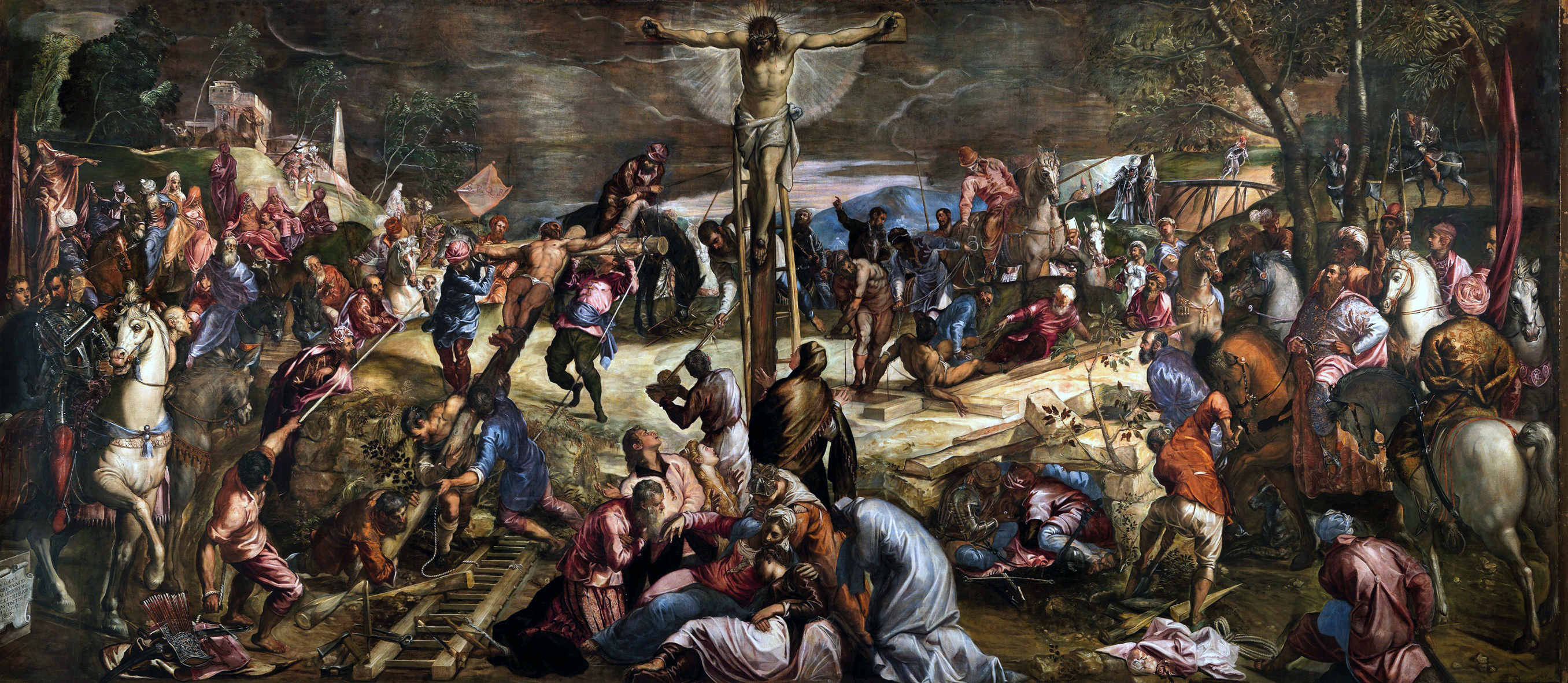
One of the most fascinating of paintings by one of the most individual of artists; one in whom merged the fruits of Renaissance scientific method with the genius of a unique sensibility. Click to see properly.
Subscribe to:
Posts (Atom)
