'The person trying to save time is trapped in "time", ie the concept of time, while the person taking his time is free of "time".'
'Yes.'
Thursday, 14 August 2008


Tuesday, 12 August 2008
Show Business Biography Book
Irish boyband sensation Westlife have successfully commissioned literary giant Ewan McIan to write an authorised biography, charting the extrarodinary group's chart-topping career. Mr McIan said that he will, however, first have to finish his upcoming critique of the modern age and the threats to its superpowers' stability, which has involved "some really serious research."
Letting Off Steam
Sociologically bent psychologists and psycholigically bent sociologists have described war as "a relatively harmless way for homicidal lunatics to relieve what might otherwise become dangerous stores of volatile repressed energies, liable to cause harm to both themselves and those nearest and dearest to them."
Insect Controversy
A hornets nest of controversy has arisen in the branch of the flighted insect world that is the world of the butterflies, where it is claimed that the butterflies were in fact, in an earlier stage of life, the earthbound caterpillar. Reactions to the shocking claims have ranged from anger, humiliated self-laceration, mockery, and even a kind of triumphant self-satisfaction.
Without having time to delve further into the storms of debate, a lone voice or two amongst the butterflies has expressed bemusement at the furore and perceived implications of the claims of the insect's evolutionary precursor. "I don't see how it in any way changes the nature of my nature now. In what sense does it make me any less of a butterfly?"
Without having time to delve further into the storms of debate, a lone voice or two amongst the butterflies has expressed bemusement at the furore and perceived implications of the claims of the insect's evolutionary precursor. "I don't see how it in any way changes the nature of my nature now. In what sense does it make me any less of a butterfly?"
Sunday, 10 August 2008
DH Lawrence, Satire, the Social Being
Satire exists for the very purpose of killing the social being, showing him what an inferior he is and, with all his parade of social honesty, how subtly and corruptly debased. Dishonest to life, dishonest to the living universe on which he is parasitic as a louse. By ridiculing the social being, the satirist helps the true individual, the real human being, to rise to his feet again and go on with the battle. For it is always a battle and always will be.
Though I should perhaps go back in artistic chronological time to an earlier point in the essay John Galsworthy to Lawrence's idea of the social being. This relates to a recent piece on The Public Arena which is described thus: "Where vast numbers of existentially unreal people vainly endeavour through sheer weight of numbers to create one real collective entity."
What do we mean by a social being as distinct from a human being? Why can't we admit them as human beings? Why do we feel so instinctively that they are inferiors?
It is because they have lost caste as human beings, have sunk to the level of the social being, that peculiar creature that takes the place in our civilization of the slave in old civilizations...The fatal change today is the collapse from the psychology of the free human individual into the psychology of the social being, just as the fatal change in the past was a collapse from the freeman's psyche to the psyche of the slave.
Lawrence says of the true individual, who has not poured his life into a false dead form that he "has at his core a certain innocence or naïveté which defies all analysis, and which you cannot bargain with, you can only deal with it in good faith from your own corresponding innocence or naïveté."
The social being is contrarily a being of compromise, unreal, cut off from the universe. As Dostoevsky says in The Brothers Karamazov: "It sometimes happens that it is precisely (the odd man) who bears within himself the heart of the whole, while the other people of his epoch have all for some reason been torn away from it for a time by some flooding wind."
And so back to the satire that seeks to kill this social being. Not the individual in whom this artificiality resides, but the artificiality itself. The chances of outright success are probably pretty slim here, so even in the absence of serious hopes of absolute success, the user of the tool might as well amuse himself and for his own health pour what would otherwise become self-harming contempt into these forms of ridicule. Satire can be double-edged though, is a corrosive, and excessive immersion in the world of the social unreality works to ruin the innocence of the satirist himself; it becoming an unseemly tool of perpetual revenge poisoning the avenger.
As Nietzsche writes: "Why did you live so long in the swamp that you became a frog and a toad yourself." And the danger for the noble man is not "that he may become a good man- but that he may become an impudent one, a derider, a destroyer."
Thursday, 7 August 2008
Book News
Controversy in bookland over the publication of a new St Francis biography to be called Don't Call Me Asshole- A Life of St Francis. The publishers defend the choice of title on the basis of "the surprisingly modern personality that was St Francis' personality, and would be still if he was alive now."
Meanwhile the Booker Prize is to adopt the Eurovision format of the public voting for the winner from next year, with bonus points awarded to books recommended by the major political parties. The public are asked, when choosing their book choice, to especially bear in mind the categories of Relevant to Our Times, and Chillingly Prescient.
An option reportedly given very serious consideration was the deciding of the award by means of a 100 metre dash, though this was eventually rejected on the basis of being "undemocratic".
Language in Error
A prominent linguist has declared that our use of the English language in today's world is "all wrong."
"The words and their meanings are all mixed up. What we say means something completely different than what we think it does," he lamented.
"The words and their meanings are all mixed up. What we say means something completely different than what we think it does," he lamented.
Tuesday, 5 August 2008
Asleep
There was a planet which through a combination of astonishing astronomical circumstances experienced a total eclipse lasting for several days. As a consequence every living thing eventually happened to be asleep at the same time, and from this sleep noone was ever to awaken. Reality needed to exist in the mind of someone and when the last exhausted mind disappeared into the calming oblivion of sleep, reality disappeared with him. There being no reality into which anyone could awaken, noone could awake.
I suppose I could have an alien visitation to the planet and with reality having a mind within which it could exist, everyone awakens- a variation on the Sleeping Beauty tale. Or ponder a collective dreamworld evolving in the minds of the sleeping populations. And perhaps within that dreamworld the given scenario could occur.
I suppose I could have an alien visitation to the planet and with reality having a mind within which it could exist, everyone awakens- a variation on the Sleeping Beauty tale. Or ponder a collective dreamworld evolving in the minds of the sleeping populations. And perhaps within that dreamworld the given scenario could occur.
Ingres, Napoleon & the Triumphant Ego
Goya is often noted for what is claimed to be his subtle yet savagely satirical portraits of the high and mighty of the Spanish court, debatable as this proposition may be, but I believe the most glorious putdown within this field of painting is the following by Ingres of Napoleon, though I'm sure Ingres would be appalled at the suggestion that his image is anything but a great portrait revealing the all-conquering greatness of a very great man.

And to admit the help of DH Lawrence from his essay, Within the Sepulchre, where he elaborates on what he calls "the false I which thinks itself supreme and infinite."
"It believes itself to have filled up the whole of the universe ... It is tremendously conceited. It assumes it has reached the limit of all space and all being. It concludes that its self is fulfilled, that all consummation is achieved."
This ego, in the form of helpful little Napoleon, is the very opposite of humility. He is the most powerful man in Europe; king apparently of the egos. But the ego is never secure. It has conquered all, and yet requires public recognition of its achievements. It cannot sit content in its own naked space, is not sufficient unto itself, and this naked space of silence is to be avoided at all cost, for here is where this ego no longer exists. Thus incidentally the emphasis on reason by the self-imagined acolytes of the materialistic universe. In 'reason' or rather language lies the continued existence of the ego-self. It is the air the ego breathes. When the layers of thought are stripped to their core, the regality of the West is found to be materialism. But this is not quite the final essence, and materialism is the clothing of the frightened, envious ego, in a state of self-sustained artificiality.
Thus the ridiculous regalia which surrounds Napoleon's physical self. King of the antheap, but remove the antheap and it is nothing. A comical, pathetic figure.
Who does this man, Napoleon, in the deepest sense think he is? Certainly not the ridiculous, self-adoring figure he appears now, once removed from the abstractions of public imagining. And this is what begins to make this painting so interesting not so much psychologically as pneumatologically, i .e. in terms of the soul. Napoleon the individual fades into unimportance here. Rather the painting serves as a perhaps uniquely perfect portrait of the ego in the state of its greatest triumph. And Ingres for his guileless faithfulness, ennobling to sitter and painter, is perfect for the task at hand. He is as much a believer in the glory at hand as Napoleon.

And to admit the help of DH Lawrence from his essay, Within the Sepulchre, where he elaborates on what he calls "the false I which thinks itself supreme and infinite."
"It believes itself to have filled up the whole of the universe ... It is tremendously conceited. It assumes it has reached the limit of all space and all being. It concludes that its self is fulfilled, that all consummation is achieved."
This ego, in the form of helpful little Napoleon, is the very opposite of humility. He is the most powerful man in Europe; king apparently of the egos. But the ego is never secure. It has conquered all, and yet requires public recognition of its achievements. It cannot sit content in its own naked space, is not sufficient unto itself, and this naked space of silence is to be avoided at all cost, for here is where this ego no longer exists. Thus incidentally the emphasis on reason by the self-imagined acolytes of the materialistic universe. In 'reason' or rather language lies the continued existence of the ego-self. It is the air the ego breathes. When the layers of thought are stripped to their core, the regality of the West is found to be materialism. But this is not quite the final essence, and materialism is the clothing of the frightened, envious ego, in a state of self-sustained artificiality.
Thus the ridiculous regalia which surrounds Napoleon's physical self. King of the antheap, but remove the antheap and it is nothing. A comical, pathetic figure.
Saturday, 2 August 2008
The Public Arena
Where vast numbers of existentially unreal people vainly endeavour through sheer weight of numbers to create one real collective entity.
Thus the excitement in certain circles about the Booker Prize: where a few other people read alot of contemporary novels and decide which one they like best, or think they like best, or think they should like best, and "the public" get to co-inhabit this public sphere, thus deepening the sense of their individual reality within this common public reality, which pseudo-consciousness is likewise strengthened by its accumulation of human numbers. Though one had better not investigate too seriously what the foundation stones of this commonality are.
The same goes obviously for all other manner of awards ceremonies; self-transcendence within the manufactured collective consciousness.
Friday, 1 August 2008
Lost Memory Not
There have been so many uses of the lost memory device that I have thought of writing a novel with the unusual device of the central protagonist not having lost his memory. The book seeks to discover why. Naturally one hopes this will be made into a film.
Thursday, 31 July 2008
What Remains Unsaid
If we allow ourselves the luxury of language there are very few things we cannot say. What these things are naturally I cannot say. Perhaps it's merely a question of knowledge, and if one did know these things one cannot say, then one could say them.
Tuesday, 29 July 2008
Clear Cut Clean Through
"Truth is simple, falseness complex? Why?"
"Falseness requires entangling complexity to delude the mind as to its falseness. The man of truth cuts the Gordian knot of complexity with the direct external blow, rather than stepping into its pathways where the point of true perspective is wholly lost."
"Falseness requires entangling complexity to delude the mind as to its falseness. The man of truth cuts the Gordian knot of complexity with the direct external blow, rather than stepping into its pathways where the point of true perspective is wholly lost."
Hatched Intellect
"Did reasoning powers bring about the existence of reasoning powers?"
"No, reasoning powers did not exist prior to the existence of reasoning powers so as to be able to bring about the existence of reasoning powers."
"No, reasoning powers did not exist prior to the existence of reasoning powers so as to be able to bring about the existence of reasoning powers."
Screen of Truth
Sociological experts have refuted claims that television "adds pounds" to individuals thereon; ie making them appear heavier than in actuality.
"The truth is that life makes one look thinner than one really is. The camera never lies."
"The truth is that life makes one look thinner than one really is. The camera never lies."

Monday, 28 July 2008
Colleen-I'll Read You A Story
Saturday, 26 July 2008
The Animal of Creation & the Dialogue of Invention
"The ability to read is man's greatest invention."
"No, you're wrong. The ability to walk is man's greatest invention."
"Yes of course."
"No, you're wrong. The ability to walk is man's greatest invention."
"Yes of course."
Friday, 25 July 2008
Shame
It is to my eternal, or at least temporary, shame that this post merely exists as an excuse to write It is to my eternal, or at least temporary shame.
Alternatively:
It is to my eternal, or at least temporary, shame that this post merely exists as an excuse to write It is to my eternal, or at least temporary shame that this post merely exists as an excuse to write It is to my eternal...
Alternatively:
It is to my eternal, or at least temporary, shame that this post merely exists as an excuse to write It is to my eternal, or at least temporary shame that this post merely exists as an excuse to write It is to my eternal...
Thursday, 24 July 2008
God is Dead. Why?
One of the most famous of pithy statements of the last few centuries is Nietzsche's "God is dead." As to the existence of an specific individual entity, whether dead or alive, somehow outside of life, naturally all is pure speculation, though if we accepted the working hypothesis of 'his' existence, then the declaration of his death would seem the height of presumption. Presumably what Nietzsche meant was the death of the concept of God, though here we have the limitless vistas of irrelevance as to agreeing as to what exactly is the nature of the human concept in the first place, then the desirability of the existence or not of this concept and all the rest of it. Nietzsche on the one hand seemed to feel it to be the opening of an existential space of pure being into which freedom the new man could stride magnificently, but on the other hand, double edged sword that the concept was, that 'God' had died because of a shrinking of man's horizons. Pettiness and egotistical barbarism were the future for the masses, while a more napoleonic egotism of power were the future for the liberated hero. Which all in all amounts to little more than points of perspective from which to view 'the antheap'.
Though the whimsical thought that has led to the words above ushering forth from my mind was a look at why this God, a living being, not a concept, might have died. And that little thought being that God received word and formed his understanding of man, just like so many of our exalted men, from the medium of the mainstream media. And naturally from the picture of reality that emerges from these effluences, God had little choice but to open his veins in shame and despair.
Though the whimsical thought that has led to the words above ushering forth from my mind was a look at why this God, a living being, not a concept, might have died. And that little thought being that God received word and formed his understanding of man, just like so many of our exalted men, from the medium of the mainstream media. And naturally from the picture of reality that emerges from these effluences, God had little choice but to open his veins in shame and despair.
Wednesday, 23 July 2008
John Carey New Work
The literary world is buzzing with excitement over the forthcoming publication of John Carey's new work, More Disingenuous Bullshit. The anti-intellectual Mr Carey, who is one of the brightest of lights within the intellectual firmament, has allegedly said regarding the provocative title, "Who knows- perhaps what I write isn't disingenuous at all. Maybe I really am this stupid."
Sunday, 20 July 2008
Ingres and Feminism
Following on from the recent post involving Jean-Auguste Dominique Ingres, a post on his much undervalued role as an intellectual patron and artistic chronicler of the liberating force of feminism. Below is one of the leading figures of the emerging movement that changed the landscape of life, Venus Anadyomène, painted by Ingres in slightly allegorical mode. Anadyomène was regarded by the ruling elites as "one of the most dangerous people in Europe" for her radical views regarding universal suffrage.
 Ingres' most important work as chronicler of the rise of feminism is the painting below, which shows the first organised meeting of like-minded women from around Europe to debate and formulate strategies for the campaign ahead. Ingres, the only male present, was requested by Anadyomène to record the event for posterity, which , given the sociological climate of the time, he intentionally misleadingly titled The Turkish Bath. Noone will deny Ingres has managed to capture something of the tension of the heated exchanges that occured at that seminal gathering.
 And finally, below is a painting of the extremist figure, still only known by her nom de plume, The Source, by which the painting is still known. She believed the ends justified the means, and women were duty bound to resort to violence to further the struggle.

 Ingres' most important work as chronicler of the rise of feminism is the painting below, which shows the first organised meeting of like-minded women from around Europe to debate and formulate strategies for the campaign ahead. Ingres, the only male present, was requested by Anadyomène to record the event for posterity, which , given the sociological climate of the time, he intentionally misleadingly titled The Turkish Bath. Noone will deny Ingres has managed to capture something of the tension of the heated exchanges that occured at that seminal gathering.


Friday, 18 July 2008
Somnambulance
Somnambulance: a vehicle for transporting people to a slow, soporific death. Otherwise known as mainstream culture. Some say the somnambulance floats atop the main stream, while others claim the somnambulance is the stream itself. Some claim the somnambulance is consciously driven by human agents, while others that it is self-propelled, merely unconsciously obeying the laws of its own being.
Thursday, 17 July 2008
Ingres, Turner & the Desire for Order
No man is a psychological island, and through the simple fact of being human is a universal being, or at least universal in the earthly sense. The individual actualises certain traits or potentialites of the universal self in his person- the personality a form of greater or lesser fluidity- and this most easily witnessed in the realms of art where inner substance takes outer form. This universality of self is naturally the sole reason art is of interest to individuals other than that of the individual creator. Whatever life the artist breathes into his work resonates with us through human commonality.
Perhaps the prime motivation of art is the urge towards unity, where the elements of existence find some cohesive form. What then becomes interesting is the extent to which the form achieved satsifies the inner nature and complexity of life, and is istelf a living extension of life. Is the art of a comparatively genuine order, reaching into the emotional and intellectual depths of life- the work of a great artist- or inconsistent with life, a false clarity, certainty at the expense of truth- for example, the childish work of a Tarantino. In the first, the artwork is an organic extension of life, whereas in the second the work simply seves the desire for form, but is more or less a parralel universe of artificiality, and will soon lie in the dust of forgotten time.
And to look at two roughly contemporary artists- Ingres(1780-1867) and Turner(1775-1851), as two examples of wildly divergent senses of being, reflected in their respective art.

And to cement the point, another beautiful, if slightly oddly shaped, doll La Grande Odalisque

In keeping with Ingres' apparent sense of the world, his style remained roughly a constant through his career. He wrote, "I am a conservator of good doctrine, and not an innovator." Such a mind is not seeking breakthroughs to intenser vision, or the like; such a desire being at odds with the classical type to whom all should be clear and simple in self-contained perfection, rather than elusive, and difficult. And in terms of this classical ideal of clarity, this also explains Oedipus' extremely violent and ludicrous self-punishing for the crime - through no real fault of his own - of transgressing the desired form of absolute order integral to his culture.

A greater painting by Ingres above, The Valpincon Bather, though the greater worth could be to a large extent down to where we are viewing the bather from, and were her face to be in view, she would most likely be revealed to be just another human doll.

And below Ingres, Rain Steam and Speed the Great Western Railway, by Turner, an artist actualising perhaps diametrically contrary psychological, spiritual aspects of the human condition. For Ingres, truth is contained firmly within the particulars of existence, especially within their physical form which offers its essence up meekly to the draughtman skills of the artist, and elusive inner reality is almost wholly non-existent. Such simple rational clarity is anathema to Turner, and his art, especially as he progressed, produces little in the way of drawing skills at all, and becomes at times squalls of virtual abstraction. Truth for him is a much more dangerous animal.
One could say there are two poles of temptation here: for the Ingres type, stagnation through excessive order, and for the Turner type a falling over from order into shapeless chaos.
For Turner the too solid flesh of the world dissolves into what might appear to be chaos, which brings to mind Blake's line, "As I was walking among the fires of hell, delighted with the enjoyments of Genius; which to Angels look like torment and insanity". Also Nietzsche's words, "You must have chaos within you to give birth to a dancing star."
(This was all written a while back, not posted as what follows is a bit shoddy, and for some reason, still extant, I don't feel like working on finishing it. I might feel sufficiently motivated in some future time, but here it is anyway)
One could describe Turner's greatest works as involving the dissolving of an unsatisfactory constricting sense of order, of life contained within an intellectual false form, where 'truth' is too easily and risklessly attained by a rationalising mind, falsely sure of itself and its surroundings. Simply dissolving an unsatisfying sense of order in itself merely leaves us with unformed chaos, however, and it is the greatness of Turner's finest works to unify the particulars of life within a more intense vision. Turner's is not a New Age calendar vision of truth, with spirituality softly presenting itself to a gentle awakening soul. That would simply be an updated version of Ingres' soft-focus classicism. Turner is in violent opposition to such a comforting order too cheaply arrived at, which quickly rings false and emanates the banal.
Thomas Mann from Doctor Faustus:
I find there is something uncomfortable about standing eye-to-eye with greatness; it is a test of courage- can one really endure that gaze?
This inhuman majesty certainly intrinsic to Turner's greatest works, but it would be ridiculous to make such test of courage claims about Ingres' soft-focus classicism.
Perhaps the prime motivation of art is the urge towards unity, where the elements of existence find some cohesive form. What then becomes interesting is the extent to which the form achieved satsifies the inner nature and complexity of life, and is istelf a living extension of life. Is the art of a comparatively genuine order, reaching into the emotional and intellectual depths of life- the work of a great artist- or inconsistent with life, a false clarity, certainty at the expense of truth- for example, the childish work of a Tarantino. In the first, the artwork is an organic extension of life, whereas in the second the work simply seves the desire for form, but is more or less a parralel universe of artificiality, and will soon lie in the dust of forgotten time.
And to look at two roughly contemporary artists- Ingres(1780-1867) and Turner(1775-1851), as two examples of wildly divergent senses of being, reflected in their respective art.

In Ingres’ own words, “Drawing is seven eights of what makes up painting. This signifying a sense of self that sees, or wishes to see, life contained within purely delineated contours, and he abhorred the visible brushstroke, in obvious contrast to artists like Rembrandt, Van Gogh and Turner - comparative primitives of the temperament, and to my mind Ingres is the creator often of a rather prissy, bloodless 'perfection', with the above painting, Odalisque with a Slave a rather typical example of what might be termed his frequent exercises in porcelain erotica. His desire for simple classical certainty fits neatly the mentioned doll-like nature of the two women, neither of whom offers the faintest threat of possessing any volatile, awkward inner life, inaccessible to the artist.
And to cement the point, another beautiful, if slightly oddly shaped, doll La Grande Odalisque

In keeping with Ingres' apparent sense of the world, his style remained roughly a constant through his career. He wrote, "I am a conservator of good doctrine, and not an innovator." Such a mind is not seeking breakthroughs to intenser vision, or the like; such a desire being at odds with the classical type to whom all should be clear and simple in self-contained perfection, rather than elusive, and difficult. And in terms of this classical ideal of clarity, this also explains Oedipus' extremely violent and ludicrous self-punishing for the crime - through no real fault of his own - of transgressing the desired form of absolute order integral to his culture.

A greater painting by Ingres above, The Valpincon Bather, though the greater worth could be to a large extent down to where we are viewing the bather from, and were her face to be in view, she would most likely be revealed to be just another human doll.
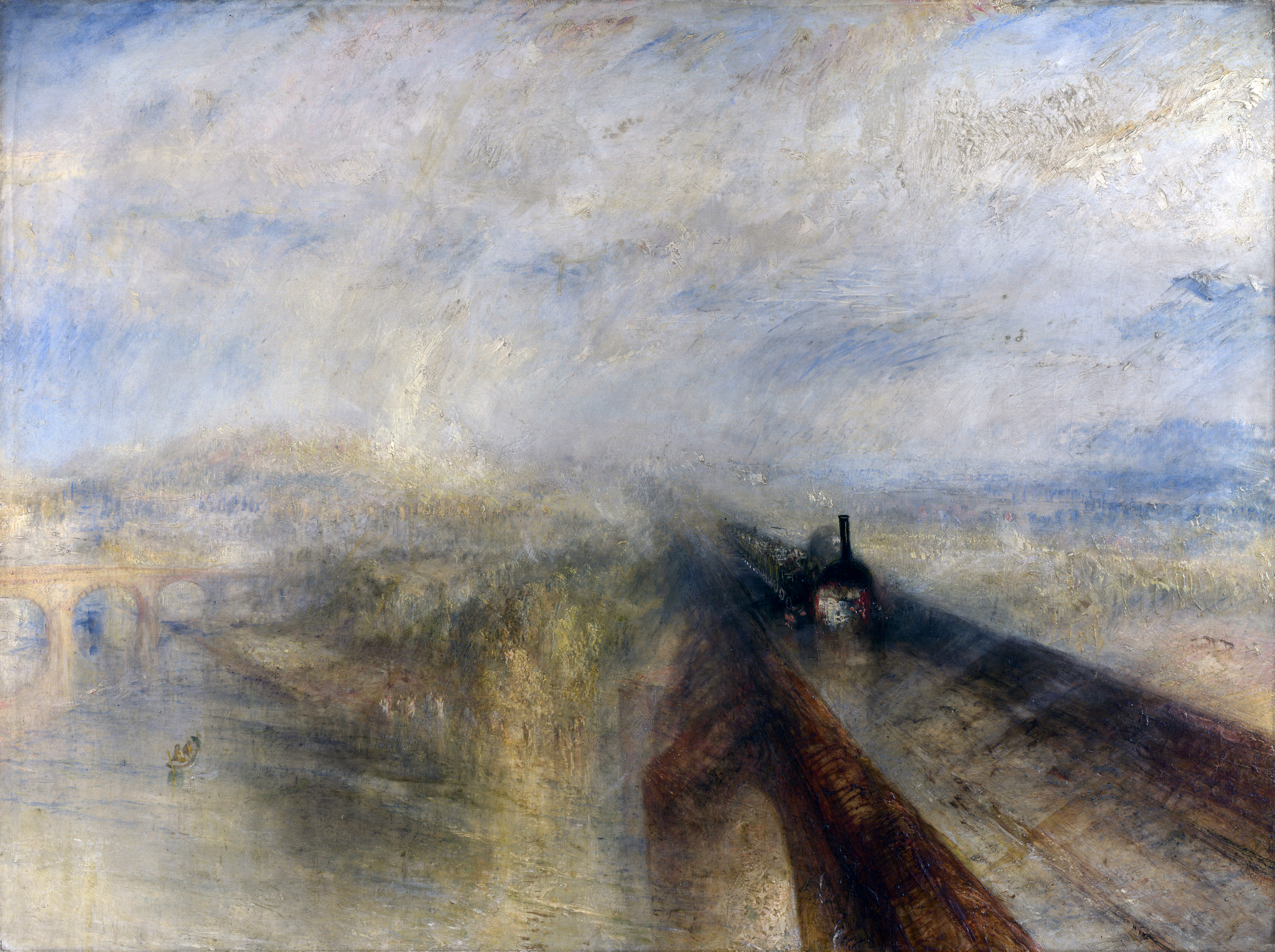
And below Ingres, Rain Steam and Speed the Great Western Railway, by Turner, an artist actualising perhaps diametrically contrary psychological, spiritual aspects of the human condition. For Ingres, truth is contained firmly within the particulars of existence, especially within their physical form which offers its essence up meekly to the draughtman skills of the artist, and elusive inner reality is almost wholly non-existent. Such simple rational clarity is anathema to Turner, and his art, especially as he progressed, produces little in the way of drawing skills at all, and becomes at times squalls of virtual abstraction. Truth for him is a much more dangerous animal.
One could say there are two poles of temptation here: for the Ingres type, stagnation through excessive order, and for the Turner type a falling over from order into shapeless chaos.

For Turner the too solid flesh of the world dissolves into what might appear to be chaos, which brings to mind Blake's line, "As I was walking among the fires of hell, delighted with the enjoyments of Genius; which to Angels look like torment and insanity". Also Nietzsche's words, "You must have chaos within you to give birth to a dancing star."
(This was all written a while back, not posted as what follows is a bit shoddy, and for some reason, still extant, I don't feel like working on finishing it. I might feel sufficiently motivated in some future time, but here it is anyway)
One could describe Turner's greatest works as involving the dissolving of an unsatisfactory constricting sense of order, of life contained within an intellectual false form, where 'truth' is too easily and risklessly attained by a rationalising mind, falsely sure of itself and its surroundings. Simply dissolving an unsatisfying sense of order in itself merely leaves us with unformed chaos, however, and it is the greatness of Turner's finest works to unify the particulars of life within a more intense vision. Turner's is not a New Age calendar vision of truth, with spirituality softly presenting itself to a gentle awakening soul. That would simply be an updated version of Ingres' soft-focus classicism. Turner is in violent opposition to such a comforting order too cheaply arrived at, which quickly rings false and emanates the banal.
Thomas Mann from Doctor Faustus:
I find there is something uncomfortable about standing eye-to-eye with greatness; it is a test of courage- can one really endure that gaze?
This inhuman majesty certainly intrinsic to Turner's greatest works, but it would be ridiculous to make such test of courage claims about Ingres' soft-focus classicism.
Wednesday, 16 July 2008
Interview
You've written many books.
Yes.
Quite a few in fact.
Yes.
What is it you like about books?
The marriage of form and content.
Could you mention some of your favourite books?
Death in Stilletos and Countdown to Terror.
Two of your own of course.
Yes.
Any others?
The Hungry Cannibal.
Another one of your own. Excellent. And you've a new book coming out next month.
Yes.
Called?
Love in Autumn.
Any advice for young writers?
Know your verbs.
Thank you, you've been a great interviewee.
Any time.
Yes.
Quite a few in fact.
Yes.
What is it you like about books?
The marriage of form and content.
Could you mention some of your favourite books?
Death in Stilletos and Countdown to Terror.
Two of your own of course.
Yes.
Any others?
The Hungry Cannibal.
Another one of your own. Excellent. And you've a new book coming out next month.
Yes.
Called?
Love in Autumn.
Any advice for young writers?
Know your verbs.
Thank you, you've been a great interviewee.
Any time.
Sunday, 13 July 2008
Establishing Guilt
A somewhat Kafkaesque recently flashed in my mind while in a supermarket and the visual stimulus of a surveillance camera entered my mind, and that creative thought being that these technological mechanisms were metaphysical instruments of justice. In earlier religious times, confession was where, as suggested by the word, people confessed their crimes, and this to the metaphysical justice system was the principle means of establishing the individual's degree of guilt. For obvious reasons, not an infallible system for the divine bureaucracy, but still ingenious - getting the individual to inform on himself; so ingenious perhaps as to be a clear manifestation of its divine origin. [This messed up Philip Dick/Kafka interpretation is to add, simply for the sake of this fictional piece - it’s not my real view!]
In the post Industrial Revolution age, the religious era declines in proportion to the increase of the as man's capacity to enter pseudo or virtual worlds of his own imagining, and so the confessional system of establishing guilt has suffered greatly. However, with the technological era has come new means of accumulating data on the individual, and the various devices now inhabiting the world such as computers, phones, surveillance cameras, are part of a metaphysical surveillance network to perform the old duties of the confessional.
This naturally a thought-piece, but interestingly it brought to mind something distinctly similar in tone, and that is the American governmental body, the Information Awareness Office, and its desire to have total information awareness . The Information Awareness Office (IAO) was established by the Defense Advanced Research Projects Agency (DARPA), the research and development agency of the United States Department of Defense, in January 2002 to bring together several DARPA projects focused on applying information technology to counter transnational threats to national security. The IAO mission was to "imagine, develop, apply, integrate, demonstrate and transition information technologies, components and prototype, closed-loop, information systems that will counter asymmetric threats by achieving total information awareness", which prosaically means absolute knowledge by 'the state' of the details of its citizens' lives. Following public criticism that the development and deployment of these technologies could potentially lead to a mass surveillance system, the IAO was defunded by Congress in 2003, although several of the projects run under IAO have continued under different funding. A rose by any other name.
And what was the logo for this totalitarian body? Quelle surprise, the old masonic All-Seeing Eye on the pyramid, with the Latin phrase scientia potentia est proudly adorned beneath. "For also knowledge itself is power." Yes, knowledge and power for whom?

Tuesday, 8 July 2008
Colours of Paradise
Anyone deserves the West who arrives with fresh energy to break up the deadly, antiseptic boredom of its civilization.
Joseph Roth- The Wandering Jews.
This West, particularly the English speaking West, under the sway of truthless materialism, produces practically nothing of any merit in film. Even its supposedly best, most acclaimed films like There Will Be Blood are in real artistic terms, lifeless. Such films a series of transcribed set-pieces, the gap between the written scene and the visual film minimal. Everything is functional, utilitarian, nothing organic and alive, despite the wonders a Daniel Day Lewis can perform. The West uses technology, inevitably given its hypnotising ambient ideologies, as mechanisms for producing unreality.
Thankfully, however, there are infusions of fresh energy to break up Roth's deadly lifelessness, and one such film is the Iranian Colours of Paradise, somewhat reminiscent of Sanjit Ray's Apu films. Watching films like this and the French-ArmenianVodka Lemon, and contrast with the lifelessness of the West's effluences, it is inescapable that the economic first world is in its sense of living life the third world. The West's ( speaking in broad terms) films are not art. They do not exist within the autonomous language of film, for which to exist as art must intimately relate to awareness of the living moment. The living moment is a foreign element to the West's unreality, and so its filmic art not art at all. Functional, arid while the Iranian director Majid Majidi has the living moment as his natural element, as of course it should for all. Technical knowledge is essential obviously for art, but this living awareness is the real primordial ground, on which everything depends.
Monday, 7 July 2008
Hypothetical Book Review
This book has changed my life in the sense that if I were not reading it I would have been doing something else. It is admittedly a shit book, but that is a minor quibble. It is also deeply relevant to today's world and the lives we live now.
The Authorities
An interesting use of language is that of 'the authorities', in the sense of those who possess and administer worldly power. Attempting to lift the word out of the soporific of the everyday usage, it seems best to fit as a throwback to an ancient religiously stratified society. Those at the apex of power are The Authorities: the possessors of mysterious hidden knowledge denied to the lumpen masses, which encloses these Authorities within a circle of power. That knowledge which is within this circle is what places them above the profane, and by necessity invisible to the profane. One could imagine Borges writing a short story on a similar theme.
Bertrand de Jouvenel writes:
The phenomenon called authority is at once more ancient and more fundamental than the phenomenon called state; the natural ascendancy of some men over others is the principle of all human organizations and all human advances.
While an online dictionary leads us back to the prosaic in describing Authority as
a. The power to enforce laws, exact obedience, command, determine, or judge.
b. One that is invested with this power, especially a government or body of government officials.
What is the connection between Jouvenal's natural ascendency of some men over others, thus rewarding them with their authority, and our modern wielders of worldly power in its various political and economic forms? Authority naturally meaning that those with it are placed above those over whom they wield this authority. Are these people really possessed of a natural ascendancy over others? Certainly interesting to see these Authorities as the equivalent of the ancient priestly class described earlier, self-selected and absolute.
Sunday, 6 July 2008
Saturday, 5 July 2008
The Castles
Many brave knights, bound by allegiance to Truth, tried to storm that great edifice, the Castle of Stupidity & Falseness. However, all efforts have predictably floundered as stupidity and falseness are their own defence, against which truth is powerless. Needles to say, the inhabitants were convinced the often insanely convoluted edifices of their stupidity were the most profound of human formulations, and proof of their progressive genius.
Our devoted knights met with similar results at the close ally of the Castle of Stupidity- the Castle of Misery. These benevolent assailants imagined they would be greeted joyfully as they liberated the inhabitants of Misery from their walled domain, but no. The inhabitants had poured themselves into their bitterness, and in it lay their very existence. He who threatened to take it away was a liar, a denier of the very ground of reality. The inhabitants sneered at the knights, accused them of vapidity and laughed at their promise of a kingdom of profundity and love. They had the best of reasons justifying their unhappiness and ignorance. "This is existence. We have tasted it, it is real." The very existence of their misery was its own proof as the substance of existence, and to say otherwise pure escapism.
Eventually and reluctantly the knights of glowing countenance moved on once it became fully clear that their efforts were wasted, and that they were themselves beginning to be infected by the unhappy malaise. Though they were pleased to find the odd inhabitant of the castle join their number, their desertion attended to by howls of derision from the most loyal.
Thursday, 3 July 2008
Unreliable Narrator
I'm sorry it offends anyone, but I make no apologies for what I write here. One of these things below.
I suffer from a traumatic artistic and spiritual quandary. When I try to pour forth my thoughts in the form of the written word, I find to my dismay words and thoughts other than those desired being crystallised in physical form, as if a second will were commandeering my will and channeling it into avenues distinct from the ones desired. I set my arm in motion and unknown contrary thoughts are produced. This emanation of thoughts that are not my own occurs with such infallible relentlessness that it cannot be attributed to deficiencies in the means of expression. Perhaps I am but one self-enclosed 'self' within a myriad of other selves within this mind-body organism.
This hijacking of my intent of course applies to all these words, including these. What I intended to write was quite different.
Monday, 30 June 2008
Satan's Little Helpers
 Above Church of Satan leader, Anton leVay, displaying the satanic handsign, which many in simple ignorance as to its symbolic significance use at rock concerts. So of course one can use this and not mean anything more than in the rock on, thumbs up sense. Ordinary adults don't however tend to use this gesture in normal life.
Below a few examples of others using this, sometimes in very formal, serious situations.


And even with the Queen. It is argued that this is a Texas college symbol that the Bushes' daughter attended. Even if accepting this explanation for the Bushes' rather demented use of this sign in utterly inappropriate circumstances, we are left with someone infantile to the point of brain damage, who even when meeting the British head of state as head of his own state, finds the temptation to flash the sign of his daughter's college irresistible. Bush is of course a member of the very disturbed Skull & Bones occult secret society, whose apparent nature is entirely in tandem with the more obvious explanation, that Bush is using this sign in the manner it is more famously recognised; ie a satanic symbol. "Satan who is the prince of thiss world," being a rather famous old line which should perhaps be taken much more literally than in loose allegorical manner.
 And Mrs Clinton.
 And Mr Clinton.

The Perceiver & Perceived
Does a television programme exist if there is noone there to see it?
Does a television programme exist if there is someone there to see it, but the television is turned off?
Does a television programme exist if there is someone there to see it, but the television is turned off?
Subscribe to:
Posts (Atom)
