What is the reality of the point of perception from which one observes oneself within disciplines such as philosophy and psychology?
Is the fullness of the reality of a sphere comprehensible to a point within that sphere, or is this an absurd proposition, and the only way a sphere can know itself fully is existentially as a sphere?
One might argue that the point of perspective expands with knowledge, though one might as easily argue that the point contracts with 'knowledge', since knowledge amounting to the notion of the point within the sphere actually knowing itself as that sphere is an absurdity.
Thus the immeasurably more satisfying indirect, analogous, artistic forms of talking about truth that actually shake the foundations of the point of perspective, rather than the rational abstract means which serve to solidify the illusion of the point, convinced it is growing in knowledge, heading for truth, just around the corner.
The more falsely sure the point within the sphere of its intellectual knowledge, the more abominable the intellectual and ensuing practical results. Thus materialistic communism, fascism/neo-conservatism, etc and a myriad of less obviously insane insanities.
Another variation is the neurotic, where the point's self certainty is undermined, but it has no faith in the sphere within which it has its existence.
Thursday, 28 August 2008


Wednesday, 27 August 2008
The Usurper
There is the belief that Christianity grafted itself onto this anciently celebrated period around the Winter Solstice, chose this period as the opportune time to celebrate Jesus' birth, and so gradually effected the passing from one faith to another relatively seamlessly. Attempting to to do otherwise would be an act of cultural crudeness doomed to failure. Now we have the same process of a new faith being grafted onto an old, and in this case the orgy of consumerism at Christmas and New Year's marks the new god of human materialism. 'Human materialism' as it as nothing to do with faith in the natural world which could theoretically amount to a kind of materialism. This modern religion is specifically restricted to the materialism of human imagining and creation in the form of consumerism. So the new faith of materialism/consumerism, which is a kind of anti-faith, as it is ultimately truthless, effects a coup d'etat and usurps the celebratory season by imposing its values onto that time, with the core rituals now involving maximum consumption of consumer goods by consumers. Out with the old, in with the new.
Monday, 25 August 2008
A Good Alibi
All evil generally requires is a good alibi to become respectable.
All evil requires is a very good alibi to become virtuous.
All one needs generally do is examine the alibi to be back with naked evil.
All evil requires is a very good alibi to become virtuous.
All one needs generally do is examine the alibi to be back with naked evil.
Sunday, 24 August 2008
The Birth of Man
Through use of remarkable imaginative powers, where I coalesce my being with the great psychic forces that lie hidden from the eyes of the profane, I have recently witnessed the great moment in time when we can truly be said to have become human; this moment being the formation of language by our upwardly mobile ancestors.
The scene: A cave somewhere in the Eastern Europe. Four hairy, smelly individuals; animal of strength & stupid of expression, gazing with all the rapture of dumb beasts at another being, but this one endowed with the faint but unmistakable signs of a deeper intelligence. He has a piece of flint held purposefully in his right hand, & emanates an air of somewhat hesitant pedagogical authority. He bursts forth into speech:
"First what we have to establish are the rules of grammar. Otherwise, all will be shapeless chaos & the darkness of utter nebulosity. If we want to make ourselves understood we need to have a firm & vigorous grasp on the subtle intricacies of our tools of communication. Grammar is the bedrock. Our language must be a perfect instrument for both the utilities of everyday living and the abstractions of philosophical discourse; able to probe & discern the subtlest shades of consciousness, and yet perfectly attuned to the rudimentaries of day to day living. One must not scorn the prosaic."
At this point I was called back to the concerns of this world, but, and with a feeling of pride, I quickly scribbled the lines,
"Rousseau, Rousseau.
More true than you did know."
The scene: A cave somewhere in the Eastern Europe. Four hairy, smelly individuals; animal of strength & stupid of expression, gazing with all the rapture of dumb beasts at another being, but this one endowed with the faint but unmistakable signs of a deeper intelligence. He has a piece of flint held purposefully in his right hand, & emanates an air of somewhat hesitant pedagogical authority. He bursts forth into speech:
"First what we have to establish are the rules of grammar. Otherwise, all will be shapeless chaos & the darkness of utter nebulosity. If we want to make ourselves understood we need to have a firm & vigorous grasp on the subtle intricacies of our tools of communication. Grammar is the bedrock. Our language must be a perfect instrument for both the utilities of everyday living and the abstractions of philosophical discourse; able to probe & discern the subtlest shades of consciousness, and yet perfectly attuned to the rudimentaries of day to day living. One must not scorn the prosaic."
At this point I was called back to the concerns of this world, but, and with a feeling of pride, I quickly scribbled the lines,
"Rousseau, Rousseau.
More true than you did know."
Thursday, 21 August 2008
Soul Discovery
Scientists are claiming to have located the precise location of the mythical philosophical entity known as "the soul," which they say they discovered while investigating a hitherto scantly explored region of the brain near the right ear. This discovery proves that the soul doesn't exist, said the scientists.
Wednesday, 20 August 2008
The Individual
"The individual is a self-sustained imaginary point oscillating between two oblivions, one of which is also imaginary."
"I find that an unsettling thought, though I haven't the faintest idea what it means."
"I find that an unsettling thought, though I haven't the faintest idea what it means."
Tuesday, 19 August 2008
Tolstoy & the Great Lie
He told himself that before proclaiming an unreasonable thing to be unreasonable one must first study the unreasonable thing. This was a trifling falsehood, but it led him to the great lie, in which he was now stuck fast.
Tolstoy, Resurrection
Most people are, obviously enough, less intelligent intellectually than the intellectuals who have attained some measure of public acclaim, however petty and ultimately false such figures might ultimately be. Even with ample forewarning of, for argument sake, the bigoted fascism of one such figure- perhaps even a favoured author- the individual tells himself, "Yes, but I will be fair and judge for myself." However, like the crowd in Shakespeare's Julius Caesar, he is very far from being able to judge for himself, and carried away by the eloquence, or simply appearance of eloquence, of the favoured author, he comes away happily reassured that the dreadful things said of the author were unwarranted, and can continue with an easy conscience in the direction he was steering himself, wholly unaware of the great vines of lies entangling that self.
Tolstoy, Resurrection
Most people are, obviously enough, less intelligent intellectually than the intellectuals who have attained some measure of public acclaim, however petty and ultimately false such figures might ultimately be. Even with ample forewarning of, for argument sake, the bigoted fascism of one such figure- perhaps even a favoured author- the individual tells himself, "Yes, but I will be fair and judge for myself." However, like the crowd in Shakespeare's Julius Caesar, he is very far from being able to judge for himself, and carried away by the eloquence, or simply appearance of eloquence, of the favoured author, he comes away happily reassured that the dreadful things said of the author were unwarranted, and can continue with an easy conscience in the direction he was steering himself, wholly unaware of the great vines of lies entangling that self.
Monday, 18 August 2008
Van Gogh's Night Café & the Descent into Hell
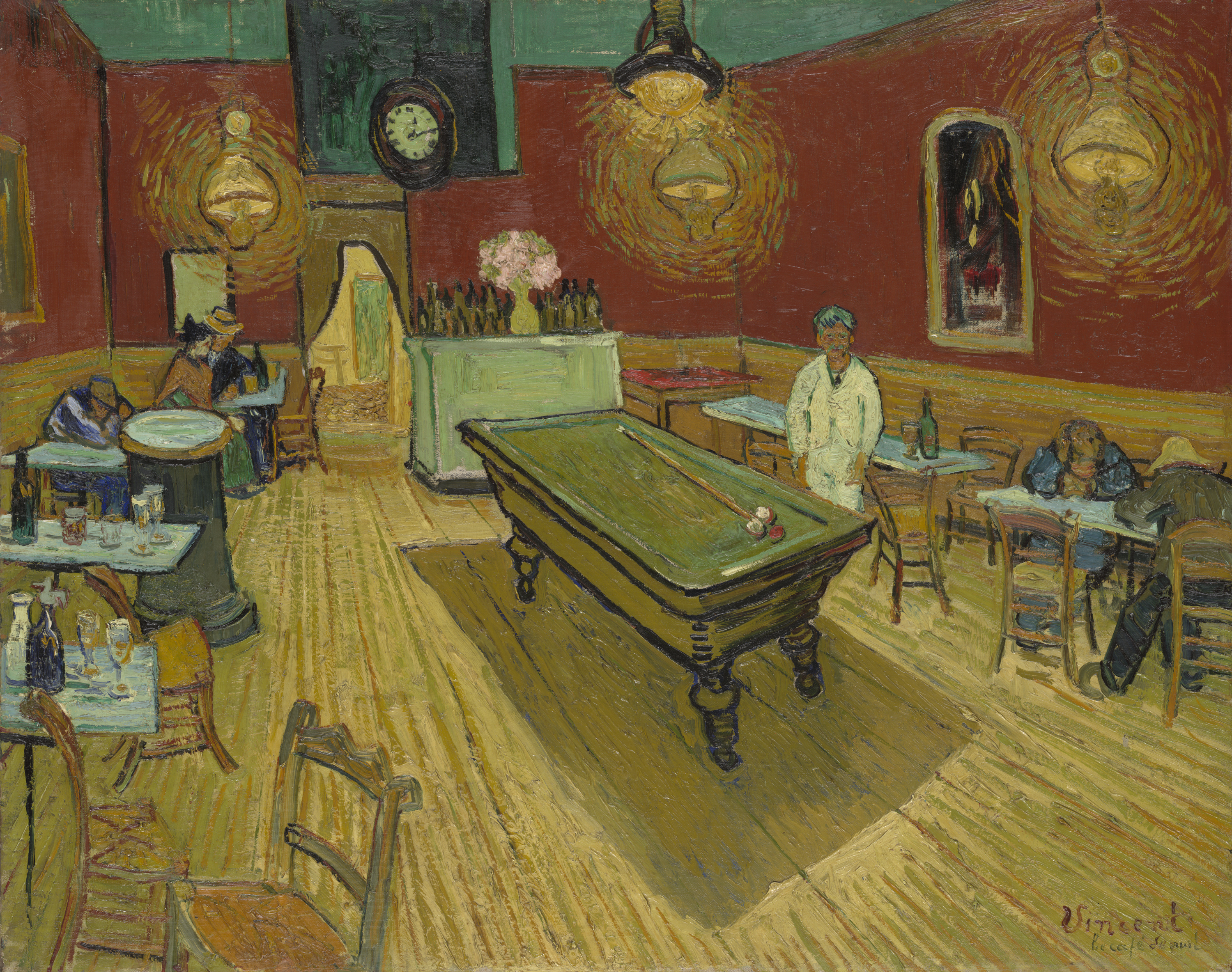
A curious line in the Christian prayer, The Apostles Creed says of Jesus that after he "was crucified, died and was buried.
He descended into hell."
As everyone knows, life is infinitely more mysterious than imagined by all but the very few, entwined as that life inextricably is with consciousness. And without wishing to pursue the possible eschatological subtleties of that heretical sounding thought of a divine consciousness entering infernal regions, that line came to mind while looking at Van Gogh's great painting, The Night Cafe, of which Vincent wrote: I have tried to express the idea that the cafe is a place where one can ruin oneself or commit a crime... The picture is one of the ugliest I have done."
The scene is saturated with hallucinatory menace; a place where Dostoevsky's Raskolnikovs and Stavrogins could inhabit with suitable unease. And of course this is far more than about mere 'place'. Just as elsewhere in Van Gogh's oeuvre, heaven is an extension of the individual consciousness united with the 'external' world, so is hell here a seamless extension of the individual mind.
*Though the resolution of the picture here does make it more unfocused and garish than in reality. Click to enlarge & it improves.
The Cannibal
"The artist cannibalises himself. When he has devoured everything, he perishes."
"The artist or the person?"
"Good question. Perhaps Hemingway realised there was nothing left to devour. His life had become a thing devoid of substance for the artist, and so..."
"The artist or the person?"
"Good question. Perhaps Hemingway realised there was nothing left to devour. His life had become a thing devoid of substance for the artist, and so..."
Sunday, 17 August 2008
El Greco- Laocoon, The Redemptor


El Greco belongs as a metaphysician(every significant artist is a metaphysician, a propounder of beauty-truths and form-theories) to no known school. The most one can say, by way of classification, is that like most artists of the Baroque, he believed in the validity of ecstacy, of the non-rational, 'numinous' experiences out of which, as a raw material, the reason fashions the gods or the various attributes of God.
Aldous Huxley- 'Meditation on El Greco' from Music at Night.
Thursday, 14 August 2008
Stopwatch
'The person trying to save time is trapped in "time", ie the concept of time, while the person taking his time is free of "time".'
'Yes.'
'Yes.'
Tuesday, 12 August 2008
Show Business Biography Book
Irish boyband sensation Westlife have successfully commissioned literary giant Ewan McIan to write an authorised biography, charting the extrarodinary group's chart-topping career. Mr McIan said that he will, however, first have to finish his upcoming critique of the modern age and the threats to its superpowers' stability, which has involved "some really serious research."
Letting Off Steam
Sociologically bent psychologists and psycholigically bent sociologists have described war as "a relatively harmless way for homicidal lunatics to relieve what might otherwise become dangerous stores of volatile repressed energies, liable to cause harm to both themselves and those nearest and dearest to them."
Insect Controversy
A hornets nest of controversy has arisen in the branch of the flighted insect world that is the world of the butterflies, where it is claimed that the butterflies were in fact, in an earlier stage of life, the earthbound caterpillar. Reactions to the shocking claims have ranged from anger, humiliated self-laceration, mockery, and even a kind of triumphant self-satisfaction.
Without having time to delve further into the storms of debate, a lone voice or two amongst the butterflies has expressed bemusement at the furore and perceived implications of the claims of the insect's evolutionary precursor. "I don't see how it in any way changes the nature of my nature now. In what sense does it make me any less of a butterfly?"
Without having time to delve further into the storms of debate, a lone voice or two amongst the butterflies has expressed bemusement at the furore and perceived implications of the claims of the insect's evolutionary precursor. "I don't see how it in any way changes the nature of my nature now. In what sense does it make me any less of a butterfly?"
Sunday, 10 August 2008
DH Lawrence, Satire, the Social Being
Satire exists for the very purpose of killing the social being, showing him what an inferior he is and, with all his parade of social honesty, how subtly and corruptly debased. Dishonest to life, dishonest to the living universe on which he is parasitic as a louse. By ridiculing the social being, the satirist helps the true individual, the real human being, to rise to his feet again and go on with the battle. For it is always a battle and always will be.
Though I should perhaps go back in artistic chronological time to an earlier point in the essay John Galsworthy to Lawrence's idea of the social being. This relates to a recent piece on The Public Arena which is described thus: "Where vast numbers of existentially unreal people vainly endeavour through sheer weight of numbers to create one real collective entity."
What do we mean by a social being as distinct from a human being? Why can't we admit them as human beings? Why do we feel so instinctively that they are inferiors?
It is because they have lost caste as human beings, have sunk to the level of the social being, that peculiar creature that takes the place in our civilization of the slave in old civilizations...The fatal change today is the collapse from the psychology of the free human individual into the psychology of the social being, just as the fatal change in the past was a collapse from the freeman's psyche to the psyche of the slave.
Lawrence says of the true individual, who has not poured his life into a false dead form that he "has at his core a certain innocence or naïveté which defies all analysis, and which you cannot bargain with, you can only deal with it in good faith from your own corresponding innocence or naïveté."
The social being is contrarily a being of compromise, unreal, cut off from the universe. As Dostoevsky says in The Brothers Karamazov: "It sometimes happens that it is precisely (the odd man) who bears within himself the heart of the whole, while the other people of his epoch have all for some reason been torn away from it for a time by some flooding wind."
And so back to the satire that seeks to kill this social being. Not the individual in whom this artificiality resides, but the artificiality itself. The chances of outright success are probably pretty slim here, so even in the absence of serious hopes of absolute success, the user of the tool might as well amuse himself and for his own health pour what would otherwise become self-harming contempt into these forms of ridicule. Satire can be double-edged though, is a corrosive, and excessive immersion in the world of the social unreality works to ruin the innocence of the satirist himself; it becoming an unseemly tool of perpetual revenge poisoning the avenger.
As Nietzsche writes: "Why did you live so long in the swamp that you became a frog and a toad yourself." And the danger for the noble man is not "that he may become a good man- but that he may become an impudent one, a derider, a destroyer."
Though I should perhaps go back in artistic chronological time to an earlier point in the essay John Galsworthy to Lawrence's idea of the social being. This relates to a recent piece on The Public Arena which is described thus: "Where vast numbers of existentially unreal people vainly endeavour through sheer weight of numbers to create one real collective entity."
What do we mean by a social being as distinct from a human being? Why can't we admit them as human beings? Why do we feel so instinctively that they are inferiors?
It is because they have lost caste as human beings, have sunk to the level of the social being, that peculiar creature that takes the place in our civilization of the slave in old civilizations...The fatal change today is the collapse from the psychology of the free human individual into the psychology of the social being, just as the fatal change in the past was a collapse from the freeman's psyche to the psyche of the slave.
Lawrence says of the true individual, who has not poured his life into a false dead form that he "has at his core a certain innocence or naïveté which defies all analysis, and which you cannot bargain with, you can only deal with it in good faith from your own corresponding innocence or naïveté."
The social being is contrarily a being of compromise, unreal, cut off from the universe. As Dostoevsky says in The Brothers Karamazov: "It sometimes happens that it is precisely (the odd man) who bears within himself the heart of the whole, while the other people of his epoch have all for some reason been torn away from it for a time by some flooding wind."
And so back to the satire that seeks to kill this social being. Not the individual in whom this artificiality resides, but the artificiality itself. The chances of outright success are probably pretty slim here, so even in the absence of serious hopes of absolute success, the user of the tool might as well amuse himself and for his own health pour what would otherwise become self-harming contempt into these forms of ridicule. Satire can be double-edged though, is a corrosive, and excessive immersion in the world of the social unreality works to ruin the innocence of the satirist himself; it becoming an unseemly tool of perpetual revenge poisoning the avenger.
As Nietzsche writes: "Why did you live so long in the swamp that you became a frog and a toad yourself." And the danger for the noble man is not "that he may become a good man- but that he may become an impudent one, a derider, a destroyer."
Thursday, 7 August 2008
Book News
Controversy in bookland over the publication of a new St Francis biography to be called Don't Call Me Asshole- A Life of St Francis. The publishers defend the choice of title on the basis of "the surprisingly modern personality that was St Francis' personality, and would be still if he was alive now."
Meanwhile the Booker Prize is to adopt the Eurovision format of the public voting for the winner from next year, with bonus points awarded to books recommended by the major political parties. The public are asked, when choosing their book choice, to especially bear in mind the categories of Relevant to Our Times, and Chillingly Prescient.
An option reportedly given very serious consideration was the deciding of the award by means of a 100 metre dash, though this was eventually rejected on the basis of being "undemocratic".
Meanwhile the Booker Prize is to adopt the Eurovision format of the public voting for the winner from next year, with bonus points awarded to books recommended by the major political parties. The public are asked, when choosing their book choice, to especially bear in mind the categories of Relevant to Our Times, and Chillingly Prescient.
An option reportedly given very serious consideration was the deciding of the award by means of a 100 metre dash, though this was eventually rejected on the basis of being "undemocratic".
Language in Error
A prominent linguist has declared that our use of the English language in today's world is "all wrong."
"The words and their meanings are all mixed up. What we say means something completely different than what we think it does," he lamented.
"The words and their meanings are all mixed up. What we say means something completely different than what we think it does," he lamented.
Tuesday, 5 August 2008
Asleep
There was a planet which through a combination of astonishing astronomical circumstances experienced a total eclipse lasting for several days. As a consequence every living thing eventually happened to be asleep at the same time, and from this sleep noone was ever to awaken. Reality needed to exist in the mind of someone and when the last exhausted mind disappeared into the calming oblivion of sleep, reality disappeared with him. There being no reality into which anyone could awaken, noone could awake.
I suppose I could have an alien visitation to the planet and with reality having a mind within which it could exist, everyone awakens- a variation on the Sleeping Beauty tale. Or ponder a collective dreamworld evolving in the minds of the sleeping populations. And perhaps within that dreamworld the given scenario could occur.
I suppose I could have an alien visitation to the planet and with reality having a mind within which it could exist, everyone awakens- a variation on the Sleeping Beauty tale. Or ponder a collective dreamworld evolving in the minds of the sleeping populations. And perhaps within that dreamworld the given scenario could occur.
Ingres, Napoleon & the Triumphant Ego
Goya is often noted for what is claimed to be his subtle yet savagely satirical portraits of the high and mighty of the Spanish court, debatable as this proposition may be, but I believe the most glorious putdown within this field of painting is the following by Ingres of Napoleon, though I'm sure Ingres would be appalled at the suggestion that his image is anything but a great portrait revealing the all-conquering greatness of a very great man.

And to admit the help of DH Lawrence from his essay, Within the Sepulchre, where he elaborates on what he calls "the false I which thinks itself supreme and infinite."
"It believes itself to have filled up the whole of the universe ... It is tremendously conceited. It assumes it has reached the limit of all space and all being. It concludes that its self is fulfilled, that all consummation is achieved."
This ego, in the form of helpful little Napoleon, is the very opposite of humility. He is the most powerful man in Europe; king apparently of the egos. But the ego is never secure. It has conquered all, and yet requires public recognition of its achievements. It cannot sit content in its own naked space, is not sufficient unto itself, and this naked space of silence is to be avoided at all cost, for here is where this ego no longer exists. Thus incidentally the emphasis on reason by the self-imagined acolytes of the materialistic universe. In 'reason' or rather language lies the continued existence of the ego-self. It is the air the ego breathes. When the layers of thought are stripped to their core, the regality of the West is found to be materialism. But this is not quite the final essence, and materialism is the clothing of the frightened, envious ego, in a state of self-sustained artificiality.
Thus the ridiculous regalia which surrounds Napoleon's physical self. King of the antheap, but remove the antheap and it is nothing. A comical, pathetic figure.
Who does this man, Napoleon, in the deepest sense think he is? Certainly not the ridiculous, self-adoring figure he appears now, once removed from the abstractions of public imagining. And this is what begins to make this painting so interesting not so much psychologically as pneumatologically, i .e. in terms of the soul. Napoleon the individual fades into unimportance here. Rather the painting serves as a perhaps uniquely perfect portrait of the ego in the state of its greatest triumph. And Ingres for his guileless faithfulness, ennobling to sitter and painter, is perfect for the task at hand. He is as much a believer in the glory at hand as Napoleon.
And to admit the help of DH Lawrence from his essay, Within the Sepulchre, where he elaborates on what he calls "the false I which thinks itself supreme and infinite."
"It believes itself to have filled up the whole of the universe ... It is tremendously conceited. It assumes it has reached the limit of all space and all being. It concludes that its self is fulfilled, that all consummation is achieved."
This ego, in the form of helpful little Napoleon, is the very opposite of humility. He is the most powerful man in Europe; king apparently of the egos. But the ego is never secure. It has conquered all, and yet requires public recognition of its achievements. It cannot sit content in its own naked space, is not sufficient unto itself, and this naked space of silence is to be avoided at all cost, for here is where this ego no longer exists. Thus incidentally the emphasis on reason by the self-imagined acolytes of the materialistic universe. In 'reason' or rather language lies the continued existence of the ego-self. It is the air the ego breathes. When the layers of thought are stripped to their core, the regality of the West is found to be materialism. But this is not quite the final essence, and materialism is the clothing of the frightened, envious ego, in a state of self-sustained artificiality.
Thus the ridiculous regalia which surrounds Napoleon's physical self. King of the antheap, but remove the antheap and it is nothing. A comical, pathetic figure.
Saturday, 2 August 2008
The Public Arena
Where vast numbers of existentially unreal people vainly endeavour through sheer weight of numbers to create one real collective entity.
Thus the excitement in certain circles about the Booker Prize: where a few other people read alot of contemporary novels and decide which one they like best, or think they like best, or think they should like best, and "the public" get to co-inhabit this public sphere, thus deepening the sense of their individual reality within this common public reality, which pseudo-consciousness is likewise strengthened by its accumulation of human numbers. Though one had better not investigate too seriously what the foundation stones of this commonality are.
The same goes obviously for all other manner of awards ceremonies; self-transcendence within the manufactured collective consciousness.
Thus the excitement in certain circles about the Booker Prize: where a few other people read alot of contemporary novels and decide which one they like best, or think they like best, or think they should like best, and "the public" get to co-inhabit this public sphere, thus deepening the sense of their individual reality within this common public reality, which pseudo-consciousness is likewise strengthened by its accumulation of human numbers. Though one had better not investigate too seriously what the foundation stones of this commonality are.
The same goes obviously for all other manner of awards ceremonies; self-transcendence within the manufactured collective consciousness.
Friday, 1 August 2008
Lost Memory Not
There have been so many uses of the lost memory device that I have thought of writing a novel with the unusual device of the central protagonist not having lost his memory. The book seeks to discover why. Naturally one hopes this will be made into a film.
Subscribe to:
Posts (Atom)
